

Compare active and passive bass electronics by identifying the pickup system, onboard preamp, control functions and power requirements separately. Then demonstrate the documented functions with a repeatable signal path. Retailers should be able to explain what each control does and what happens when power is unavailable before recommending a model or publishing its specification.
Make “active” a precise description
The word “active” can refer to a powered pickup system or to an onboard preamp. Ask which component the description covers. An instrument can combine passive pickups with a powered preamp: Ibanez’s SR4505 specification is a manufacturer example of that combination.
Record pickup type, preamp or EQ, switching functions and battery requirements in separate fields. “Active bass” on its own leaves several practical questions open. It does not identify the battery arrangement, prove that a bypass switch is fitted or explain which controls remain available in another mode.
| Field | What the retailer needs | How to confirm it |
|---|---|---|
| Pickups | Type, positions and any switching functions. | Exact model record or circuit documentation. |
| Preamp / EQ | Which controls adjust which functions. | Control diagram and operating instructions. |
| Power | Specified batteries, access and handling instructions. | Manufacturer instructions for that version. |
| Mode switching | What is bypassed and what still needs power. | Documented circuit behaviour, followed by an appropriate sample check. |
Map controls before the demonstration
Prepare a control card using the manufacturer’s names. Separate master volume from pickup balance, tone controls from EQ, and a frequency selector from a pickup selector. If controls are stacked, show the two functions clearly. A central detent may help locate a setting, but its presence alone does not establish what the control changes.
Use the drawing supplied for the exact version or a verified photograph with an approved key. Do not label controls by copying the arrangement of another bass. Similar-looking knobs can operate different circuits, and a product photograph normally cannot identify the components hidden inside the instrument.
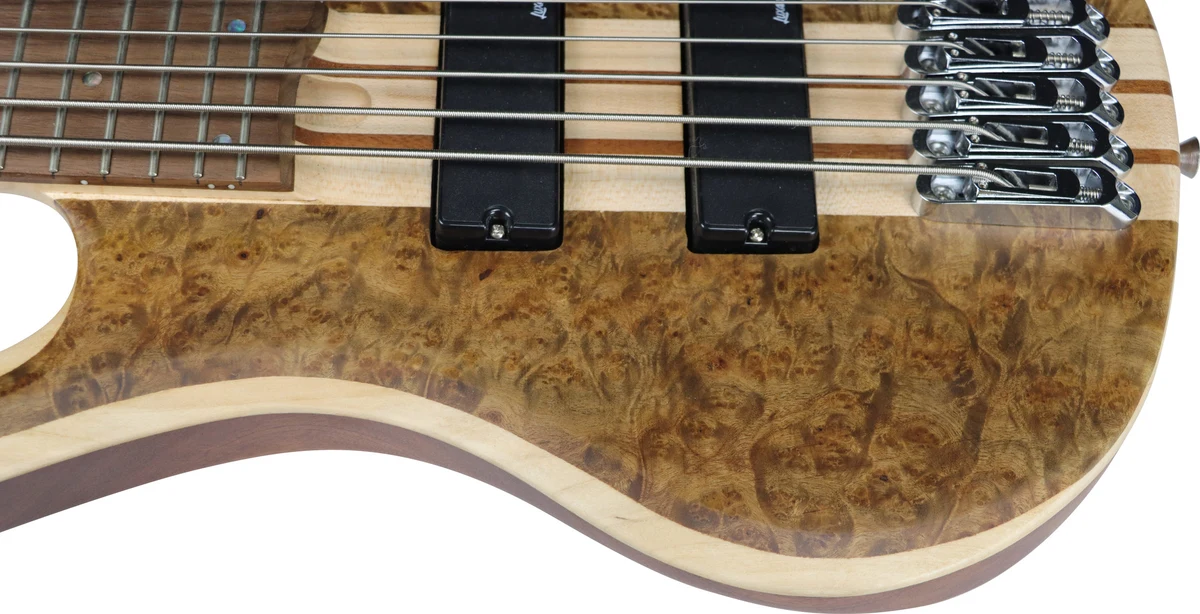
The LUXARS S-B60-5 product record lists volume, pickup balance, bass, mid and treble controls, plus a mid-frequency selector. That is a useful starting list for a model-specific demonstration card. It is not a reason to assign functions to positions in a photograph without checking the layout.
Use a repeatable demonstration path
Write down the amplifier or interface, input selection, cable and relevant settings. Disable nonessential effects or record their settings. Establish the starting control positions from the model instructions; do not assume every control is neutral at noon. Use the same short musical passage when demonstrating one function at a time, and return to the starting setting before the next comparison.
Keep listening level under control. When an adjustment changes output level, a louder result should not become an unexplained claim of better tone. Make any input or playback-level change visible in the demonstration notes. If the signal distorts or disappears, check the documented power and signal path before attributing the result to the pickups.
Invite the customer to use the controls needed for their own playing situation. Their useful choice may be a simple control layout or a wider set of adjustments. The number of knobs is not a reliable way to rank instrument quality. Staff need a clear explanation of each documented function.
Confirm power and bypass behaviour
Check the specified power arrangement and safe access procedure for the actual bass. Keep replacement information with the instrument’s records. Fender’s bass manual explains that some active instruments cannot operate passively when their batteries are depleted. Do not assume a switch guarantees battery-free operation.
Distinguish an EQ-bypass setting from a documented passive signal path. Ask which powered components remain in use and which controls operate in each mode. Follow the model instructions when checking this behaviour; opening the electronics or disconnecting power is not a routine sales demonstration unless the procedure is appropriate and authorised.
For storage and handover, use the manufacturer instructions for cable connection and battery care. Avoid promising a universal battery life. Record any sample problem and the steps already checked so that a qualified service person can continue without repeating an unexplained test.
Publish the functions customers can actually select
A useful listing names the pickup configuration, confirmed controls, mode options and relevant power information. Include a legible control key where one has been verified. Keep the exact model and revision attached to that key, especially when product photographs show several variants.
If a field is not available, request it before turning it into a sales promise. A photograph can support a statement about visible pickup placement or access covers. It cannot provide a battery voltage, circuit topology or bypass function. Use the specification review checklist to keep those sources separate.
Questions to resolve before a recommendation
Does an active preamp mean the pickups are active?
No. Identify the pickups and preamp separately. A manufacturer can specify passive pickups with a powered EQ, so the word “active” needs a component-level explanation.
Does an active/passive switch make every bass usable with a flat battery?
No. Confirm the actual signal path and the manufacturer’s stated behaviour for that model. The switch label alone is insufficient.
Prepare a bass range with clear operating information
Review the current electric bass records and send the models, required control functions and your sales channel to sale@luxarsmusic.com. Request the operating information needed for your demonstration and listings before deciding on the range.
 English