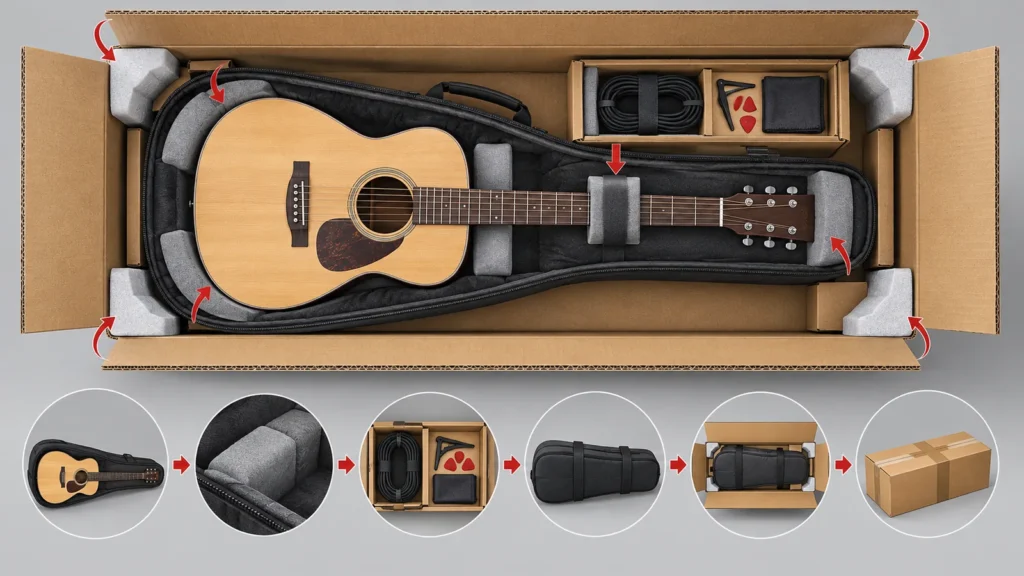
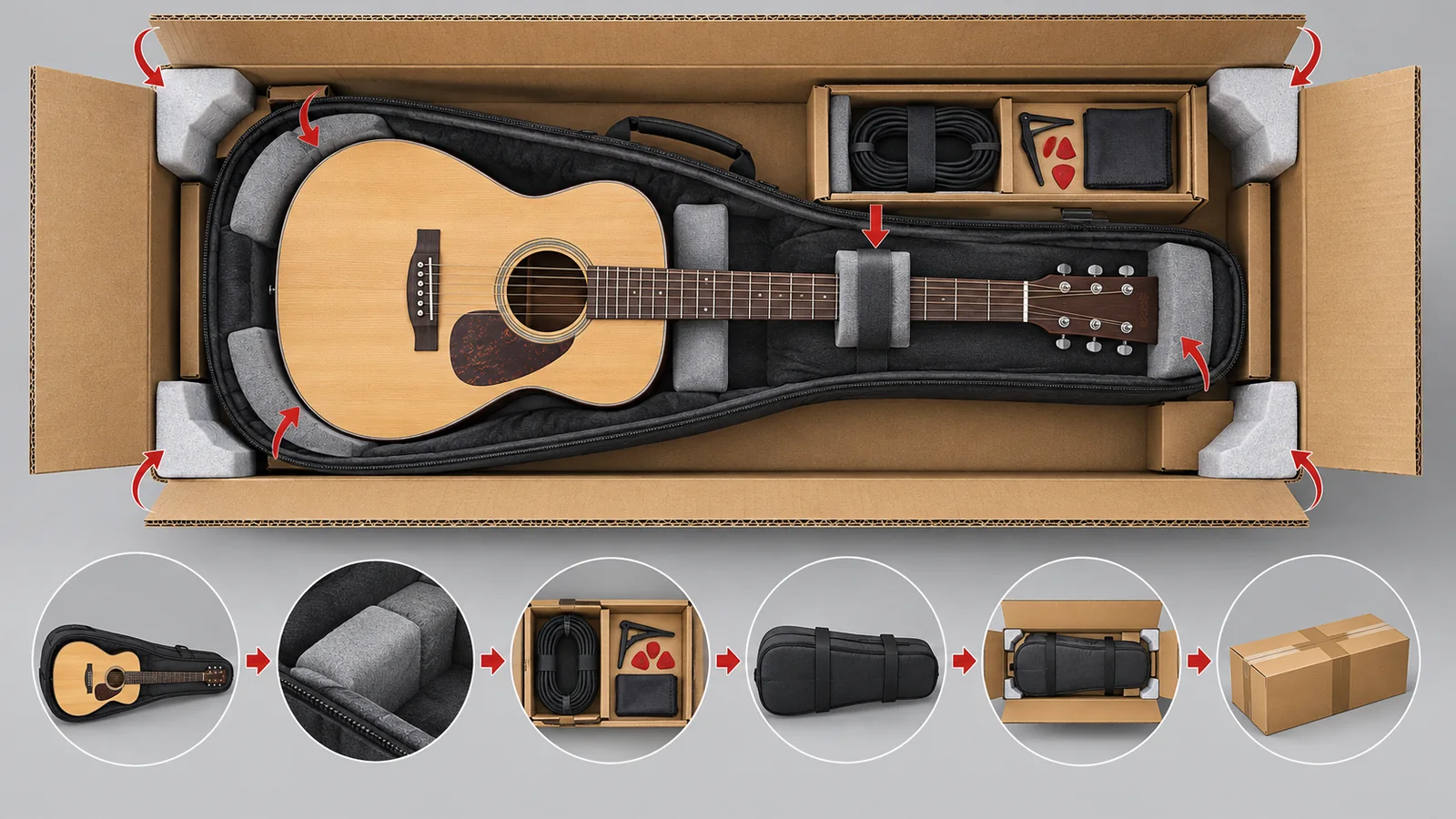
Shipping damage is not controlled by one piece of foam or a fragile label. For a wholesale guitar order, protection comes from a connected system: the instrument is prepared correctly, vulnerable points are kept away from hard contact, movement is limited inside the first package, that package is restrained inside a suitable outer carton, and the whole pack is reviewed for the route and handling method.
The practical answer is to approve packaging as part of the product, not as an afterthought. Define the exact guitar and included items, document the packing sequence, test whether anything can shift, record carton dimensions and weight, and keep photographs of the approved pack-out. The final method should be agreed for the actual model, destination, sales channel and carrier. A method suitable for one acoustic guitar sent by parcel may not be suitable for a pallet of electric guitars moving through several transfer points.
Why wholesale guitar packaging needs its own specification
A guitar combines a long neck, a wider body, a finished surface and several projecting or movable parts. Those features create different risks in the same package. The headstock and neck must not become levers when the carton is dropped or compressed. The body must not slide. Tuners, switches, tremolo arms, cables and tools must not move against the finish. The carton must also remain manageable through loading, storage, customs examination and final delivery.
Wholesale orders add another issue: repeatability. A carefully packed sample proves only that one instrument can be protected. A usable order standard must show that the same sequence can be followed across models, cartons and packing teams. It should identify which details are common to the range and which change by body shape, case type or accessory set.
Treat packaging as a controlled record with its own revision. Connect it to the model code, finish, package contents, carton marks and approved sample. If the instrument or included items change, review whether the inner support and outer carton also need to change.
Start with the route and unit of handling
Before choosing materials, describe how the order will move. Important questions include:
- Is each guitar expected to travel as an individual parcel, in a master carton or on a pallet?
- Will the order move by air, sea, road or a combination?
- How many transfers or local deliveries are likely?
- Will the distributor break down the shipment and send individual units to dealers?
- Does the e-commerce seller need packaging that can survive a second outbound shipment?
- Are there carrier limits for length, dimensional weight, carton construction or prohibited materials?
- Will the destination require specific labels, documents or material declarations?
The answer affects more than cost. A package that reaches a distributor safely may not be ready for parcel reshipment after the outer protection is removed. If dealers will receive individual units, decide whether each unit carton is designed for that step or whether a separate overpack is required.
Do not copy a carrier recommendation into a purchase order without checking the current service and destination. Carrier rules, surcharges and claim procedures vary. Use current route-specific guidance from the carrier or forwarder and preserve the agreed commercial responsibility in the order documents.

Prepare the guitar before adding protection
The first layer is the instrument itself. Confirm the model, finish and included components before packing. Photograph the guitar and its identifiers in a consistent condition. The packing instruction should state how the strings, controls and removable parts are prepared without implying one universal method for every design.
Common preparation points include:
- setting string tension according to the approved shipping method;
- separating strings from the fingerboard or finish where contact could mark the surface;
- removing or securing tremolo arms and other detachable parts;
- protecting switches, control knobs, end pins and output connections from direct pressure;
- placing tools, cables and accessories in a defined compartment;
- using clean, non-abrasive material next to the finish;
- confirming that no loose item can travel across the body or neck.
FedEx guidance for stringed instruments recommends reducing string tension and using a strong box with cushioning. Reverb’s guitar-packing guidance likewise emphasizes securing movable parts and preventing movement. These are useful principles, but the approved LuxarsMusic order method should still identify the exact instrument and package rather than relying on a generic instruction.
Protect the headstock without creating a pressure point
The headstock deserves a model-specific review. A support that looks protective may create leverage if it presses against a vulnerable angle. Keep the headstock away from hard carton surfaces and prevent side-to-side movement, but do not force it into an unnatural position. Check how the neck is supported relative to the body and whether a drop or compression event would transfer force into the neck joint.
The correct arrangement depends on headstock angle, tuner layout, case or bag design and the inner support. Record photographs from the side and above so later packers can see the intended clearances. A written note such as “add foam near headstock” is too vague when the location of the foam determines whether it protects or increases risk.
Keep the finish away from unsuitable contact
Materials touching the guitar should be clean, dry and appropriate for the finish and expected temperature. Printed newspaper, dirty reused material and adhesive surfaces should not contact the instrument. A protective bag or wrap should not trap a loose metal item against the body. If a surface-sensitive finish or long route requires a specific barrier, identify the approved material instead of describing it only as plastic or paper.
The package should also be easy to open without placing a knife near the guitar. Plan the orientation of seams, accessory compartments and opening instructions. Receiving damage caused while opening a carton is different from transit damage, but both can be reduced by better package design.
Restrain the instrument inside the first package
The objective is controlled restraint, not maximum pressure. A guitar should not slide, rotate or strike the package wall during normal handling. At the same time, inner supports should not distort the neck, bridge, controls or body.
Review the following areas:
- lower-body and side clearances;
- neck and neck-joint support;
- headstock clearance;
- protection around tuners, switches and bridge components;
- separation between the instrument and accessories;
- bag or case fit;
- top and bottom protection;
- the path by which impact loads could reach the instrument.
Close the bag, case or inner carton and perform a controlled movement check. If the guitar or accessories can be heard or felt moving, reopen the package and correct the source. Do not simply add material everywhere. Identify where movement occurs and whether the solution introduces pressure elsewhere.
A hard case is not automatically a complete shipping package. It may protect the instrument but still need cushioning and a suitable outer carton. A soft bag may improve surface protection but not provide sufficient structural resistance on its own. Define the complete system that was approved.
Choose and document the outer carton
The outer carton must be suitable for the packed weight, dimensions and handling method. Record its internal and external dimensions, construction reference, closure method and orientation. When a package is reused, inspect its corners, seams, punctures, moisture exposure and compression history; a box that looks clean may no longer have the strength of a new one.
Center the inner package and fill planned clearances so it cannot move inside the outer carton. Protect vulnerable ends and edges. Seal all required seams with appropriate packing tape, keeping the current shipping label clear and removing or covering obsolete routing labels. Weigh and measure the finished carton from the outside because carriers may use the final external dimensions.
Avoid publishing a single carton size as a universal LuxarsMusic standard unless it has been verified for every named model. Body shape, scale, headstock, bag, included items and sales-channel requirements can change the needed dimensions.
Design accessory placement as part of the pack-out
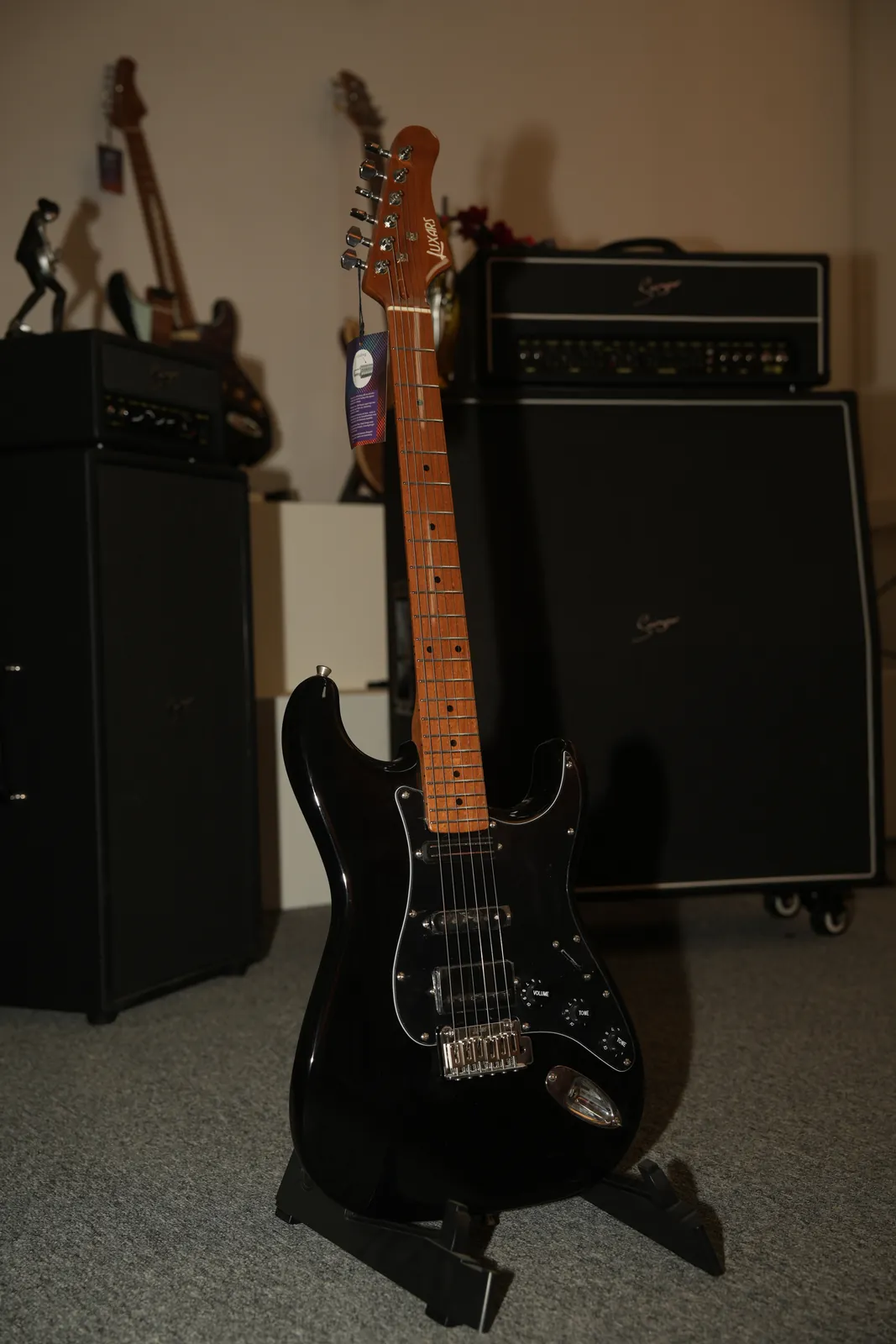
Missing or loose accessories are common receiving problems. Use a package-content list that names what is included and where it is placed. Small items can be grouped in a sealed, identifiable compartment. Long or rigid items should not rest across the guitar. Batteries, liquids or regulated components, if any, require separate route-specific review.
The product page, quotation, packing list and physical package should agree. If a bag, cable, tool or spare item is optional, do not show it as included without a label. This protects listing accuracy as well as the instrument.
Validate the approved pack-out
Packaging validation should be proportional to the order and risk. At a minimum, review a fully packed unit using the intended components. Record:
- model and package revision;
- every material and component used;
- the packing sequence;
- internal clearances and restraint points;
- completed weight and external dimensions;
- closure and label positions;
- movement-check result;
- photographs before closure and from every outer side;
- any trial, drop, compression or transport test that was actually performed;
- the person and date of approval.
Do not claim a package meets a test standard unless the method, sample, conditions and result are documented. An internal handling trial can be useful without being described as formal certification. For higher-risk routes or valuable configurations, discuss appropriate testing with a packaging specialist, carrier or laboratory.
| Packaging review point | Evidence to retain | Decision question |
|---|---|---|
| Instrument preparation | Dated pre-pack photographs and checklist | Are strings, controls and detachable parts prepared as agreed? |
| Inner restraint | Open-package views from above and side | Can the guitar or accessories shift or contact a hard surface? |
| Headstock and neck | Close views of support and clearance | Does the support protect without adding harmful leverage? |
| Outer carton | Carton reference, dimensions and closure photos | Is the carton suitable for the packed unit and route? |
| Finished pack | Weight, dimensions and all-side photographs | Can the shipped configuration be identified later? |
| Validation | Actual test or movement-check record | What was tested, and what remains an assumption? |
Review Packaging Before the Order
Planning an acoustic, classical or electric guitar order for distribution or online sales? Send LuxarsMusic the models, destination, sales channel and packaging requirements that matter to your operation. We can organize the product and package questions for review before order details are finalized. Send Your Requirements through the inquiry form, WhatsApp +86 13620576554 or info@luxarsmusic.com.
Control consistency during the order
Once the pack-out is approved, convert it into a short visual instruction. Use the same model and package revision found in purchasing and receiving records. Define which photographs are required during shipment inspection and how many units or cartons are sampled. The sample plan should reflect the order size, model mix, route and previous findings rather than an unexplained fixed percentage.
Check for substitutions in foam, bags, accessory boxes, cartons or tape. A change may be harmless, but it should not be assumed equivalent based on appearance. Review whether it changes fit, contact surfaces, strength, dimensions, labeling or recyclability requirements.
Carton marks and SKU labels should remain readable and consistent. Mixed-model shipments need a clear relationship between unit labels, carton labels, packing list and purchase order. This makes receiving faster and prevents unnecessary opening of cartons merely to identify contents.
Prepare the distributor’s receiving team
Protection continues after dispatch. Send the distributor the approved package reference, carton count, model allocation and receiving instructions before arrival. Explain which exterior conditions should be recorded before unloading or opening, which photographs are needed, and who should be contacted when an exception is found.
If visible damage appears, the receiver should follow the carrier’s current procedure and note the condition on the delivery record where required. Original packaging may need to be retained for inspection. The receiving team should not discard evidence, repair the instrument immediately or mix affected units back into saleable stock before responsibilities are understood.
Common wholesale guitar shipping mistakes
- approving the guitar while leaving packaging as “standard”;
- using the same support for different body or headstock designs without checking fit;
- allowing tools or detachable parts to move inside the package;
- relying on a hard case without an appropriate outer package;
- filling every void so tightly that pressure transfers to the neck or controls;
- measuring the box before it is fully packed and sealed;
- reusing weakened cartons without inspection;
- changing a packaging component without updating the reference;
- publishing formal test or certification language without evidence;
- failing to send receiving instructions and approved pack-out images to the buyer.
Frequently asked questions
Should guitar strings be completely removed for shipping?
There is no universal answer for every instrument and route. Many carrier and marketplace guides recommend reducing string tension, but the exact method should suit the guitar design and approved packaging plan. Record the chosen condition so the receiving team knows what to expect.
Is a hard case enough for international guitar shipping?
Usually it should be treated as one part of the system, not automatically as the shipping container. The guitar must be restrained in the case, and the case generally needs cushioning and a suitable outer carton. Confirm the current carrier requirements for the route.
How can a buyer check whether the guitar is moving inside the carton?
Use a controlled movement check after the inner and outer packages are closed. If movement or rattling is detected, reopen the package and identify the exact source. Do not add pressure indiscriminately.
Should every guitar model use the same carton?
Only when fit and protection have been verified. Different body shapes, scales, headstocks, bags, cases and accessory sets can require different support or dimensions. Link the carton and inner components to the model or approved group of models.
What shipping photographs should be retained?
Keep the instrument before packing, each inner protection stage, accessory placement, closed inner package, open outer carton, sealing, shipping label and all exterior sides. Include the model, carton reference, date and shipment identifier in the controlled record rather than relying on image timestamps alone.
Who decides whether damaged packaging requires a claim?
Follow the carrier, insurer and contract procedure for the actual shipment. Exterior damage does not always mean the guitar is damaged, but it should be documented before the evidence is disturbed. Preserve the packaging until the responsible parties confirm what is required.
Conclusion
The most reliable way to reduce shipping damage is to make packaging repeatable and reviewable. Prepare the instrument, control every loose part, protect vulnerable clearances, restrain the guitar without harmful pressure, use a suitable outer carton and keep a clear record of the approved pack-out. Then connect that record to shipment inspection and receiving.
For a B2B buyer, this process is valuable even when no damage occurs. It makes product identity clearer, reduces disputes about package contents and gives the receiving team a practical reference. Packaging becomes part of the product information system instead of an unrecorded task at the end of an order.
Discuss Your Guitar Packaging Requirements
LuxarsMusic has supported guitar product and channel requirements since 2016. Tell us your destination, sales channel, guitar categories and any packaging or labeling points you need to review. Ask for Product Information through the inquiry form, WhatsApp +86 13620576554 or info@luxarsmusic.com. Commercial terms are shared privately; no retail prices are published on this B2B website.
Sources and further reading
- FedEx, “General Guidelines for Unique Items: Stringed Musical Instruments”
- FedEx, “How to Pack and Ship a Guitar”
- Reverb, “How to Pack and Ship a Guitar (Electric, Acoustic, Bass)”
- LuxarsMusic, “How to Inspect and Approve a Guitar Sample Before a Wholesale Order”
- LuxarsMusic, “Product Images and Listing Data for Online Guitar Sellers”
Related Buyer Guides
Continue your review with our guides to sample approval process, product images and listing data, guitar specification review.
 English