
For a retailer or distributor, choosing acoustic guitars is not about finding one model that appears to suit everyone. A useful catalog gives buyers clear choices in body size, construction, playing comfort, appearance and price position—without filling the range with models that compete against one another.
Key takeaways for acoustic guitar buyers
- Start with the customers and sales channels you actually serve, then build the specifications around those needs.
- Use body size, construction, finish and feature differences to give each model a clear reason to exist.
- Ask for consistent product data and photography before approving a model for an online or printed catalog.
- Evaluate samples as a range, not only as individual guitars, so that price steps and feature upgrades remain easy to explain.
- Keep the first assortment focused. A smaller, well-defined range is easier to train staff on, list online and reorder.

Begin with the market, not a specification sheet
A common assortment mistake is to collect attractive specifications first and decide where the guitars belong later. The more practical order is the reverse. Define the player, the retail environment and the expected use before choosing the model.
A neighborhood music shop may need approachable instruments that are comfortable during short in-store trials. A regional distributor may need a compact range that can work across independent retailers with different customer profiles. An online seller needs enough visible and measurable differences to prevent three similar guitars from looking identical on a product grid. Music schools may place more weight on comfort, repeatable specifications and straightforward replacement decisions.
Before discussing individual models, write down five facts: the main sales channel, likely player level, preferred body size, expected retail position and the number of SKUs the channel can support. That short brief is more useful than beginning with a long list of woods, finishes and decorative options.
Use body size to create meaningful choice
Body dimensions affect both playing comfort and the way customers perceive an acoustic guitar. Smaller bodies are often easier for younger players, travelers and players with a smaller frame to hold. Larger bodies generally offer more low-end depth and a more substantial physical presence. Taylor’s official body-shape guidance describes smaller bodies as producing a more controlled voice, while larger bodies tend to offer greater volume and low-end depth. Fender’s acoustic body guide also notes that body depth and shape influence resonance, projection and balance.
For retail planning, this does not mean that every large guitar should be described as “better” or every compact guitar as “beginner.” It means the catalog should state why the size is there. A compact model can serve comfort and portability. A full-size cutaway can serve players who want a familiar stage-ready silhouette and access to higher frets. The label should connect the physical difference to a real customer situation.

Separate construction tiers clearly
Construction is one of the easiest ways to create a logical step-up range, but only when the descriptions are precise. Buyers should be able to see whether a specification refers to the top, the back and sides, the neck, the fingerboard or a decorative veneer. Terms such as “solid,” “laminate” and “wood pattern” should not be mixed together.
Solid wood and layered materials serve different commercial positions. Fender’s buying guidance explains that a solid top generally resonates more freely, while laminate construction is widely used to make instruments available at a lower price point. For a retailer, the useful question is not which material wins in every situation. It is whether the construction, price position and customer expectation agree with one another.
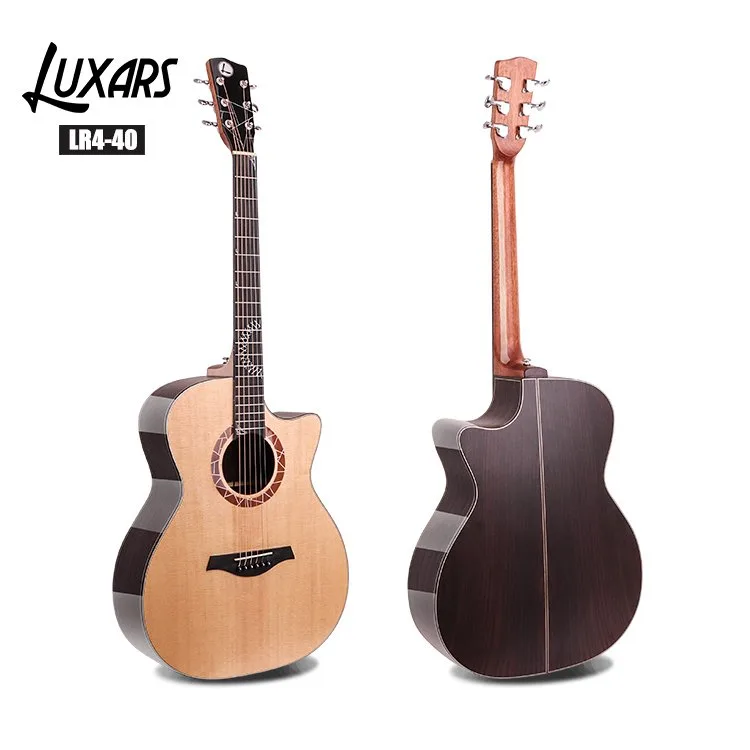
LuxarsMusic’s current acoustic range provides examples of how specifications can establish separation. The LR1-36 is listed as a 36-inch all-solid acoustic with a Grade A spruce top and Grade A mahogany back and sides. The LR4-40 is a 40-inch cutaway model listed with a Grade A spruce top and Grade A rosewood back and sides. Those differences give a buyer specific points to inspect and compare; final specifications should still be reconfirmed when requesting current product information or samples.
Make every SKU easy to explain
If sales staff need several minutes to explain why two models are different, the assortment probably needs work. Each SKU should have one primary role and two or three supporting reasons for being in the range. A simple planning matrix is often enough:
| Range role | Customer need | Useful points of difference | Catalog requirement |
|---|---|---|---|
| Accessible everyday model | First purchase, casual use, broad retail appeal | Comfortable body, straightforward finish, clear core specifications | Simple benefits, accurate dimensions, complete image set |
| Step-up model | Player wants a noticeable material or feature upgrade | Construction change, cutaway, upgraded components or finish detail | Side-by-side comparison with the entry model |
| Premium statement model | Experienced player or higher-value retail presentation | Distinctive wood selection, appointments and refined finishing | Detailed photography, specification verification and sample review |
This framework does not force every buyer into three price bands. It simply ensures that every new model adds a recognizable choice instead of repeating what is already available.

Check the specifications that affect selling and service
A useful product sheet should do more than name the top wood. Ask for a consistent set of fields across every acoustic model: overall size, body shape, scale length, nut width, top construction, back and side construction, neck material, fingerboard and bridge material, finish, strings, nut and saddle material, cutaway status, electronics if fitted, available colors and packaging information.
Consistency matters because missing fields create work later. A sales representative may have to ask the same question repeatedly. An e-commerce team may invent its own labels. A retailer may compare two products using different measurement conventions. None of these problems is dramatic by itself, but together they slow listing, training and reordering.
Playability information also deserves a place in the sample review. Check neck feel, fret ends, action, nut slots, tuning stability and whether the setup is appropriate for the intended customer. These observations should be recorded against an agreed sample or specification rather than turned into vague claims such as “professional quality.”
Planning an acoustic guitar range?
Share your target market, sales channel and preferred body sizes with LuxarsMusic. We can provide current product information and discuss suitable next steps.
Review samples as an assortment
When several samples arrive, avoid reviewing them in isolation. Put them in the intended order—from the most accessible model to the highest-positioned model—and ask whether the differences remain obvious without looking at the price. Compare comfort, finish, materials, hardware, visual identity and the quality of the supplied product data.
This is also the time to identify unnecessary overlap. Two guitars may look different in photographs yet occupy the same role once a customer holds them. Conversely, two visually similar guitars may deserve separate positions if one has a compact body and the other offers a full-size cutaway format. The purpose of the review is not to select the largest number of models. It is to create a range that makes sense at a glance.

Prepare the range for online selling
An acoustic guitar can be well chosen and still perform poorly online if the product information is incomplete. Each listing should use the same naming order, measurement units and specification labels. The main image should make the body shape immediately recognizable. Additional images should cover front, back, side profile, headstock, bridge, controls when present and important finish details.
Avoid writing eight nearly identical descriptions with only the model number changed. Explain who each model is for, how it differs from the adjacent model and what the buyer should notice. This creates better information for retail teams and gives search engines and answer systems a clearer understanding of each page.
Final acoustic guitar assortment checklist
- Is the intended customer and sales channel defined?
- Does every model have a distinct role in the range?
- Are body size and shape differences easy to explain?
- Are construction terms precise and consistent?
- Can the step-up value be seen in specifications and photographs?
- Have samples been checked for setup, fretwork and finish?
- Are all required product data fields complete?
- Are listing images available in consistent angles and resolution?
- Do product pages link to the relevant category and inquiry route?
- Can the team reorder the same specification without ambiguity?
Frequently asked questions
How many acoustic guitar models should a retailer start with?
There is no universal number. Start with the smallest range that covers the important customer groups and price positions in your channel. Add a model only when it introduces a clear difference in size, construction, features or visual direction.
Should a catalog include both compact and full-size acoustics?
Often yes, if the customer base includes players with different comfort and portability needs. The catalog should explain the use case for each size rather than treating the compact model only as a cheaper alternative.
Is solid wood always the best choice for a retail range?
Solid wood can support a higher product position and different tonal expectations, but it is not the only valid construction. The right choice depends on customer expectations, price position, climate, handling and the role of the model in the range.
What should be confirmed before ordering acoustic guitar samples?
Confirm the model code, size, construction, finish, components, strings, available colors, packaging and the purpose of the sample. Use the same checklist when the sample arrives so that the review is tied to the requested specification.
Can LuxarsMusic help with product information for online listings?
LuxarsMusic works with retail, distribution and e-commerce partners on product information and channel coordination. Available materials and current model details should be confirmed for the specific products under discussion.
Sources and further reading: Taylor Guitars: Acoustic Guitar Body Shapes; Fender: Acoustic Body Shapes; Fender: Acoustic Guitar Buying Guide.
Tell Us About Your Market
Tell LuxarsMusic about your sales region, customer profile, preferred acoustic guitar sizes and product requirements. Our team will respond with relevant product information and practical next steps. You can also contact us by WhatsApp at +86 13620576554 or email info@luxarsmusic.com.
