
A cutaway provides space beside the neck for reaching upper frets. For a retailer, the decision starts with how the customer uses that part of the fingerboard, then extends to body fit, neck access and the full model specification. Choose the actual instrument by those conditions. A cutaway label does not establish its sound, materials, electronics or suitability for every player.
Jump to a section
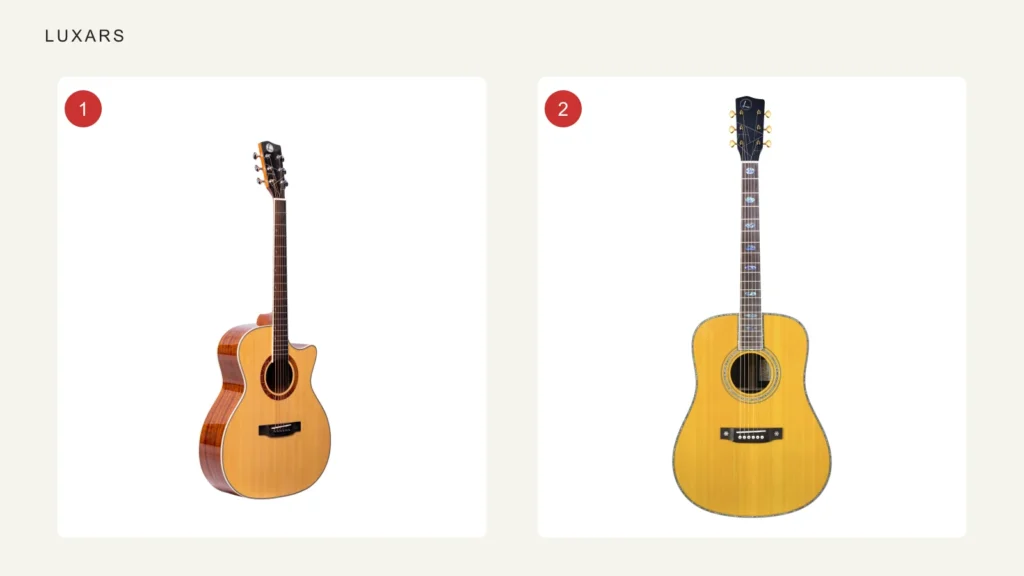
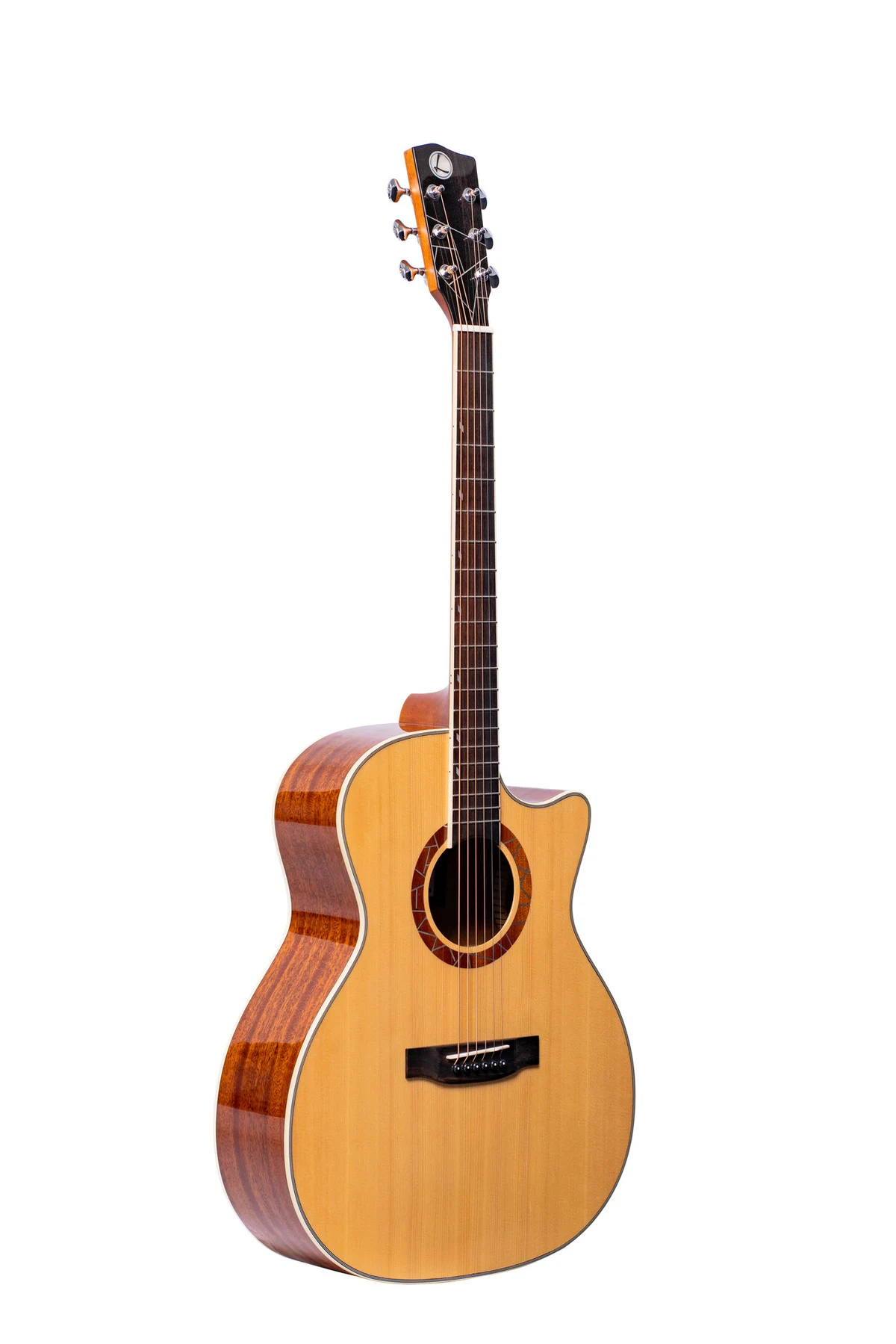
1: WY-530SS cutaway photograph. 2: LR5D non-cutaway photograph. Images are arranged independently and are not a common dimensional scale or a sound test.
Identify the task the cutaway needs to serve
Taylor’s cutaway explanation describes the indentation in the upper, treble-side part of the body near the neck and its role in upper-fret access. That definition is useful when a shop explains the feature. It is separate from a claim about how much of the upper register an individual player will comfortably use on a particular instrument.
Ask the customer to show the chords, melody or lead passage they expect to play. Someone using mainly lower positions may give more weight to body feel, appearance or other specifications. A player who regularly moves above the body joint has a reason to examine the cutaway and neck-heel area closely. Neither situation establishes one body outline as a better instrument in general.
Use the relevant playing passage in the demonstration. Observe where the fretting hand meets the body, how it approaches the higher positions and whether the instrument remains comfortable in the intended posture. A stated fret count identifies how many frets the model has; it does not show which upper positions will feel accessible to that player. Examine the neck joint, heel shape and hand position together.
Keep body outline and construction in separate fields
The R2-K/R2-M specification describes an HPL cutaway acoustic body. The WY-530SS page describes an all-solid auditorium body with a cutaway. These models demonstrate why a shared cutaway feature does not make two acoustic guitars equivalent in construction. Review each model’s own top, back, sides, neck and fingerboard information.
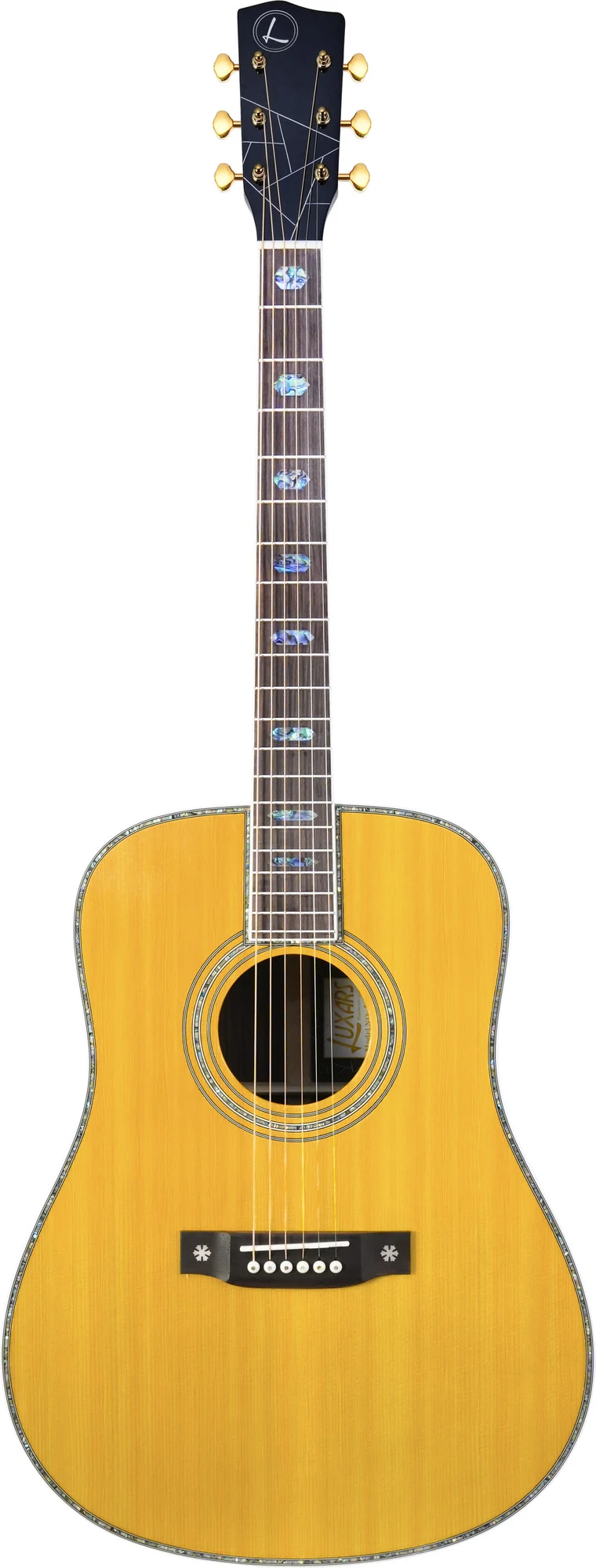
The LR5D page identifies a 41-inch all-solid dreadnought; its product photographs show the traditional non-cutaway outline. Use that outline description to identify the photographed instrument. Its declared solid spruce top and solid rosewood back and sides belong in separate material fields. Do not turn an outline comparison between LR5D and WY-530SS into a test of cutaway effects, because the models also differ in other stated construction and body characteristics.
| Selection question | What to compare | How to record the result |
|---|---|---|
| Does the buyer use upper positions? | The actual passages and frets they need | Intended playing task and observed access |
| Is the guitar comfortable to hold? | Body dimensions, seated position and standing position | The sample and posture used |
| What materials are declared? | Top, back, sides and other components separately | Model-specific construction fields |
| Is amplified use needed? | Confirmed pickup, preamp, output and power requirements | The quoted version’s electronic configuration |
| Does an accessory fit? | Actual outline and dimensions against the bag or case | The exact accessory and fit check |
Make the neck-access demonstration repeatable
Begin with a tuned sample in its normal playing setup. Invite the customer to play familiar lower-position material, then the upper positions relevant to their music. Use a passage they expect to play so the demonstration reflects their needs.
Check the heel area as well as the opening beside it. A deep-looking cutaway in a photograph may still leave a particular hand position awkward. Conversely, a customer may find their required passage accessible on a traditional outline. Record the observation against the actual sample and task, rather than creating a rule for all players with similar experience or hand size.
If the shop compares several instruments, note string set, tuning and setup differences. A high action or an unfamiliar neck profile can affect the customer’s impression independently of the body outline. Staff should be able to explain which observations concern reach and which concern the general playing setup. Refer adjustment questions to a suitable technician when necessary.
Model details for this comparison
Open the model specification and request the measurements needed for your comparison.
WY-530SS
Published model fields
- Construction
- All-solid auditorium body with cutaway
- Top
- Grade A solid spruce
- Back & sides
- Solid mahogany
Confirm body dimensions, neck access and any fitted electronics for the quoted version. Assess upper-fret reach on the actual sample.
Ask about WY-530SSR2-K / R2-M
Published model fields
- Body
- HPL: koa wood-grain texture on R2-K; flamed maple texture on R2-M
- Construction
- Cutaway acoustic body
Confirm body dimensions, neck access and any fitted electronics for the quoted version. Assess upper-fret reach on the actual sample.
Ask about R2-K / R2-MLR5D
Published model fields
- Top
- Solid spruce
- Back & sides
- Solid rosewood
Confirm body dimensions, neck access and any fitted electronics for the quoted version. Assess upper-fret reach on the actual sample.
Ask about LR5DCompare sound as a separate review
For a sound comparison, use the actual identified samples in a recorded listening arrangement. Keep the playing passage, position and listening conditions reasonably consistent. Note construction, body format, strings and setup, because a comparison of two different models does not isolate the cutaway as the cause of a tonal observation.
Describe what was heard from those samples and avoid a universal ranking. A shop should not promise that every non-cutaway guitar is louder or that every cutaway produces less bass. Such a claim needs an appropriate comparison and supporting evidence. The retailer can still help a buyer choose by letting them assess the instruments they are considering.
This also keeps listing language accurate. “Cutaway acoustic guitar” is an outline description. “All-solid auditorium with cutaway” adds a declared construction and body format when the model supports those fields. Neither phrase supplies a measured volume, sustain result or amplified-sound specification.
Plan the acoustic models to compare
Share the customer roles and playing tasks your range needs to cover. Include the model references and material fields you want confirmed. Discuss your acoustic range with LUXARS and request comparable specifications before grouping models only by their cutaway shape.
Do not infer electronics from the cutaway
A cutaway and a fitted pickup are different features. Review the specific version’s electronic information when a customer wants to connect to an acoustic amplifier, mixer or recording equipment. Ask what pickup and preamp are supplied, which controls are present and whether the system needs power. A cutaway photograph does not answer those questions.
Likewise, a customer’s preference for an unplugged instrument should be discussed against the full quoted configuration. Keep any optional fitting or alternate version identified in the enquiry. Avoid adding an electronic-system brand to a product listing because a visually similar model uses it. For stock planning, this separation prevents a body-shape choice from becoming an unsupported package promise.
Give each outline a clear role in the range
Build the range around identifiable buyer needs. A model selected for upper-position access should be easy to demonstrate for that purpose. A model selected for a traditional outline should still have a clear specification and an appropriate body-fit discussion. Give the sales team the reasons for offering each option, without claiming that either design guarantees better sales.
For an online product page, show the full front outline and the area where the neck meets the body. Add relevant side or rear views when available. Keep the images associated with the correct model and finish. Confirm case compatibility from dimensions and an actual fit check rather than from the nominal size printed in a title.
Frequently asked questions
What is an acoustic guitar cutaway?
It is an indentation beside the neck in the upper part of the body, intended to help access higher frets. The actual access depends on the complete instrument and the player’s position, so a sample demonstration remains useful.
Does every player need a cutaway?
No. Start with the positions and passages the customer expects to use. Upper-position playing gives a reason to examine the feature; body fit, other specifications and appearance can carry more weight for another buyer.
Does a cutaway mean that a guitar has a pickup?
No. Body outline and electronics are separate specification fields. Confirm the pickup, preamp, output and power requirements for the quoted version when amplified use is part of the purchase.
Can R2-K and WY-530SS be compared as equivalent cutaway models?
They share a cutaway feature, but their published construction descriptions differ. R2-K/R2-M have an HPL body; WY-530SS is described as an all-solid auditorium. Compare the complete model records and samples.
Does the cutaway alone determine a guitar’s sound?
A body-outline label does not provide a sound measurement. Review identified samples and record the other differences between models. Keep a listening observation attached to that comparison instead of presenting it as a universal cutaway rule.
Sources and related guides
- Taylor’s explanation of cutaways, for the general definition and access purpose.
- LUXARS specifications and photographs for R2-K/R2-M, WY-530SS and LR5D.
- Continue with the acoustic-size guide and the HPL and solid-top material guide.
Request a model-specific comparison
Tell LUXARS your company, market, sales channel and the acoustic models under consideration. Explain whether upper-position access, body fit, declared materials or amplified use drives the enquiry. Request product information, email sale@luxarsmusic.com, or contact WhatsApp +86 13620576554.
 English