
Compare acoustic guitars by their declared construction, not by the appearance of their wood grain. HPL, solid-top and all-solid describe different things, and a guitar can combine several materials. For retailers and distributors, the useful question is which model fits a customer need and whether its product information explains the top, back, sides and other components accurately.
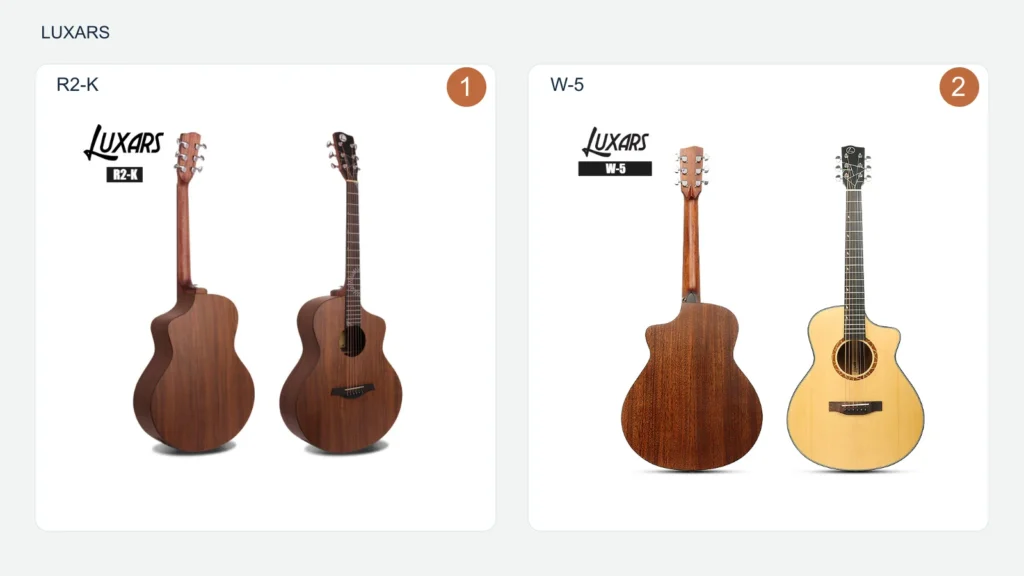
Real product photographs: R2-K and W-5. Labels refer to their published construction; photographs do not establish internal layers.
Key takeaways
- A wood-grain surface is not evidence of solid-wood construction.
- Read top, back and sides as separate specification fields.
- Solid-top does not automatically mean all-solid.
- Compare photographs, written specifications and samples together.
- Keep material language consistent across listings, quotations and model records.
Start with the meaning of each material description
HPL means high-pressure laminate. It can carry a wood-grain surface, so a koa or flamed-maple appearance needs a precise description. In its materials FAQ, Martin explains that its HPL wood pattern is not a wood veneer. That is a useful terminology reference; it does not establish the composition or performance of another brand’s particular instrument. For a LUXARS model, use the published model specification and request further information when a component is not fully described.
A solid-top description concerns the soundboard. It does not tell you whether the back and sides are solid, laminated or another construction. Likewise, a species name such as mahogany is not enough, by itself, to establish that a component is solid wood. An all-solid body description requires the relevant top, back and side information. Separate the material name, its construction and its surface appearance rather than collapsing them into one selling phrase.
This distinction matters when products reach different sales channels. A short marketplace title, a store display card and a distributor spreadsheet may describe the same instrument. If one says “koa finish,” another says “koa guitar” and a third says “solid koa,” the customer is being given three different messages. Resolve that inconsistency before creating the listing or placing an order.
Read the LUXARS examples component by component
The R2-K/R2-M product page identifies both models as HPL acoustic guitars. R2-K has a koa wood-grain texture; R2-M has a flamed-maple texture. Those are surface designs on HPL, not declarations of solid koa or solid maple bodies. Their published specification separately lists a mahogany neck and engineered-wood fingerboard and bridge. A retailer can explain the visible difference without changing the material claim.
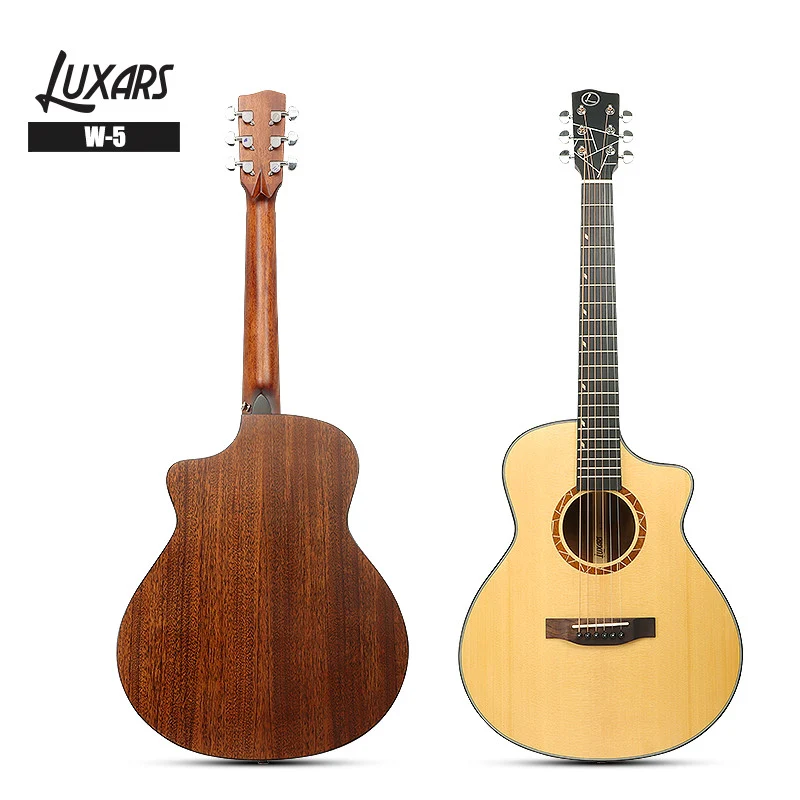
The W-5 specification describes a solid spruce top, mahogany back and sides, a mahogany neck and a rosewood fingerboard. Its solid-top description should remain attached to the top. The back-and-side field does not justify silently upgrading the product to an all-solid description. By contrast, the LR5D page explicitly presents an all-solid dreadnought with a solid spruce top and solid rosewood back and sides.
| Published model | Relevant material information | Suitable listing language | Avoid inferring |
|---|---|---|---|
| R2-K | HPL body with koa wood-grain texture | HPL acoustic guitar with koa texture | Solid koa construction |
| R2-M | HPL body with flamed-maple texture | HPL acoustic guitar with flamed-maple texture | Solid maple construction |
| W-5 | Solid spruce top; mahogany back and sides | Solid-top, 36-inch thin-body acoustic guitar | All-solid body from the top field alone |
| LR5D | Declared all-solid body; solid spruce and rosewood | 41-inch all-solid dreadnought, with the stated component materials | Unlisted specifications or performance results |
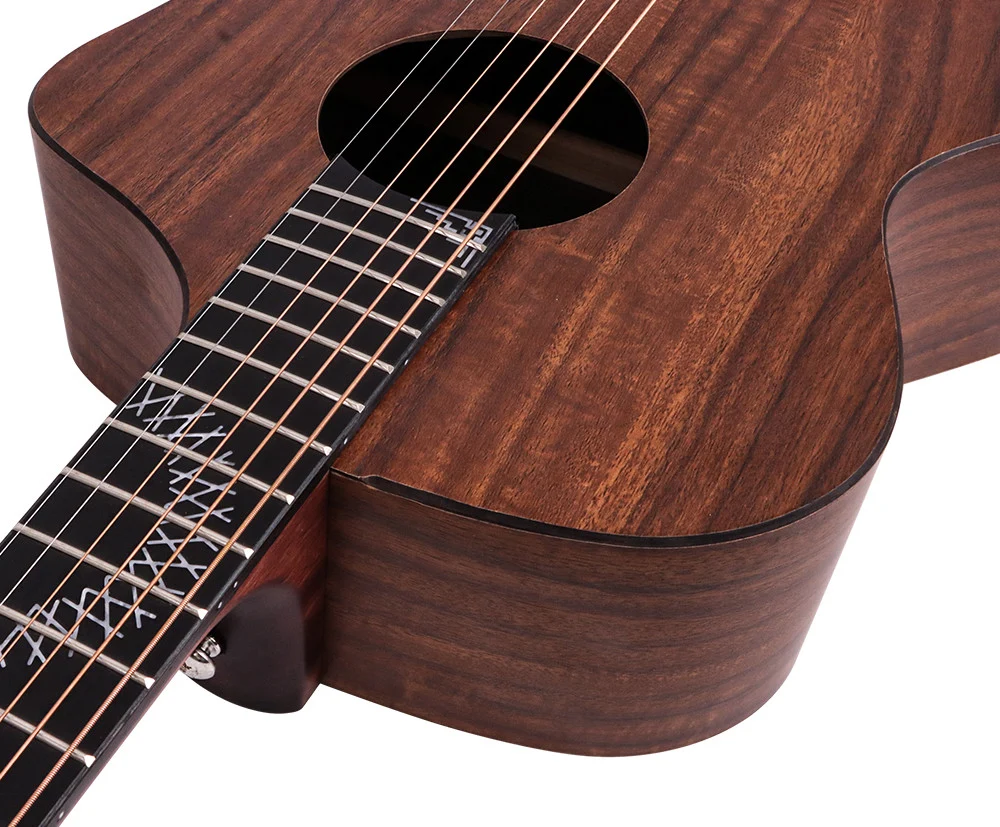
Photographs show useful design information: the cutaway, decoration, finish and photographed component arrangement. They cannot establish an unseen material layer. Keep the image caption tied to what is visible, and keep the material description tied to the approved specification. This makes the listing more informative without turning a close-up into a material certificate.
Build a specification record that survives handovers
Create a separate record for each model and version. At minimum, distinguish the top, back, sides, neck, fingerboard, bridge and finish. Add the model reference, photograph set and the date on which the supplier confirmed the information. If the wording changes later, retain the confirmed version used for the quotation or listing instead of overwriting the earlier record without context.
Use the same fields in the product page, catalogue spreadsheet and purchase discussion. A staff member should be able to trace “solid spruce top” back to the relevant model record. If information is incomplete, ask a targeted question: “Does this back-and-side description specify solid construction?” is more useful than asking for a general quality statement. Do not fill missing details by copying them from a neighbouring model.
This is particularly important for visually similar variants. R2-K and R2-M share a model family, but their photographed textures must be named correctly. Keep their names and image folders separate, even when a supplier page presents both together. A buyer comparing variants should see a real design difference, not an accidental image swap or an unsupported material hierarchy.
Compare your acoustic guitar requirements
Preparing a retail or distribution range? Send the model references, target market and material fields you want to confirm. Discuss your acoustic guitar requirements with LUXARS before turning a short catalogue description into a customer-facing claim.
Compare samples under a recorded set of conditions
Written information and sample review answer different questions. The specification explains what the model is declared to contain. A sample helps a buyer assess that particular instrument’s appearance, handling and playing response. Neither should be substituted for the other. A photograph cannot replace a construction record, and a construction label cannot predict every player’s preference.
When comparing samples, record the tuning, fitted strings, general setup, playing position and listening environment. Use a repeatable playing passage and include the intended user experience: seated comfort, fingerboard feel, control of dynamics and presentation in the channel. If the conditions differ, note the difference rather than attributing every observation to the material category.
Treat descriptions of sound as observations from the reviewed samples. Do not claim that HPL always loses to solid wood, or that one material guarantees better volume, sustain or sales. The same caution applies to durability. A general material discussion is not proof of a particular model’s resistance to moisture, heat, impact or wear. Model-specific performance claims need model-specific evidence.
Connect materials to a clear retail role
A useful assortment gives each model an identifiable role. One buyer may favour a particular appearance and handling experience; another may prioritise a stated top construction or a different body format. The job of the retailer is to make those differences easy to understand. It is not necessary to call every option superior or to imply that a distinctive texture is a rarer solid tonewood.
Present the model name, declared construction, body format and relevant photographs together. In an online listing, place the important material fields near the specification table, where customers can compare them. In a store, use the same wording on display cards and in staff notes. This keeps an enquiry from becoming a correction exercise after the customer has already formed an expectation.
Use a material-label checklist before publishing
- Confirm the exact model and variant name.
- Separate surface texture from material and construction.
- Check the top, back and sides individually.
- Keep neck, fingerboard and bridge descriptions in their own fields.
- Match photographs to the model being offered.
- Remove unverified upgrades such as “all-solid” or “solid koa.”
- Record which questions still need a supplier response.
- Align the listing, quotation and internal catalogue record.
Frequently asked questions
Does a koa wood-grain finish mean a solid koa guitar?
No. A surface can display a koa-style grain without being a solid koa component. The published R2-K description identifies koa texture on HPL. Use that full wording, and request a component-level specification if you need to establish a different material claim.
Is a solid-top acoustic guitar the same as an all-solid guitar?
No. Solid-top establishes the construction of the top. An all-solid description also needs the relevant back-and-side information. W-5 and LR5D illustrate why these labels should be read separately rather than treated as interchangeable categories.
Can product photographs confirm the guitar’s materials?
They can support identification and show the photographed appearance and components. They do not reliably establish internal layers or the construction of every part. Review the written model specification and a properly identified sample alongside the photographs.
Which material fields should a retailer request for each model?
Request the top, back, sides, neck, fingerboard and bridge, with construction stated separately where relevant. Also ask for finish, model reference and variant-specific photographs. Targeted questions help prevent missing details from being guessed or copied between products.
What should buyers record when comparing HPL and solid-top samples?
Record model identity, specification version, photographs and the conditions of the sample review. Note handling and playing observations separately from declared construction. Keep tuning, strings and setup information visible so the comparison is useful when another colleague repeats it.
Sources and further reading
- LUXARS R2-K/R2-M specifications, W-5 specifications and LR5D specifications.
- Martin materials FAQ, for general HPL terminology.
- Continue with the acoustic guitar size guide or the electric guitar bridge guide.
Tell us about your market
For model-specific material details, tell LUXARS your company, market, sales channel and the models you are considering. Include the component descriptions you need clarified and any sample-review priorities. Request product information, contact WhatsApp +86 13620576554, or email sale@luxarsmusic.com.
 English