

A wholesale guitar order can be commercially agreed and still become difficult to execute. The usual problem is not one dramatic mistake. It is a chain of small differences: a model name used in one file but not another, an approved colour without a reference, accessories shown in photographs but omitted from the purchase order, or shipping documents prepared from an older quantity.
The practical answer is to coordinate the order through one controlled record. It should connect the quotation, purchase order, approved specification, sample decisions, packaging instructions, production changes, inspection evidence and shipment documents. Each important field needs an owner, a current value and a clear approval point.

Start with one order identity
Give the project one stable order reference and use it in every related file. A buyer may have an internal purchase-order number, while the supplier has a quotation or sales-order number. Record both, but do not let conversations use several informal names for the same order.
The order header should identify the buyer, supplier, destination market, invoice and delivery contacts, currency, agreed trade term, requested timing and document language. Incoterms® 2020 rules can help define cost, risk and transport obligations, but the chosen rule must be written with the named place or port. It does not replace the product specification, payment terms or local import requirements.
Build a line-level product table
Every guitar line should be identifiable without relying on a photograph or chat history. Use a table that can be checked by purchasing, production, inspection, logistics and receiving teams.
| Field | What to record | Why it matters |
|---|---|---|
| Model identity | Brand, model code, category and revision | Prevents the same guitar being described under different names |
| Configuration | Handedness, size, string type, hardware and electronics | Separates true variants from marketing descriptions |
| Finish | Approved colour name, reference image or sample and allowed variation | Reduces subjective colour disputes |
| Quantity | Units by model and finish, plus carton or pack quantity | Keeps order, production and packing totals aligned |
| Included items | Bag, cable, tools, manual, spare parts and labels | Distinguishes standard contents from optional accessories |
| Packaging | Inner protection, carton, marks, barcode and document requirements | Connects product approval to shipment preparation |
Keep units and measurement points explicit. “Nut width 43” is incomplete; “nut width 43 mm at the nut” is usable. Material statements should come from the approved specification rather than visual assumption. If a field is not confirmed, mark it open instead of filling the gap with a likely value.

Control specification and sample revisions
A sample is useful only when its identity is recorded. Note the model, configuration, finish, sample date and the specification revision it represents. Separate accepted items from requested changes. A comment such as “sample approved with lower action” is incomplete unless the target, measurement method and affected production are defined.
When a change is requested, issue a short change record with the old value, new value, reason, affected lines, timing impact and approver. Update the master specification after approval. Do not overwrite the earlier version; production and inspection may need to establish which revision applied at a particular point.
Use our guitar sample inspection checklist to structure identity, workmanship, setup, electronics, finish and packaging feedback before a bulk order is released.
Agree the approval gates
- Commercial gate: models, quantities, currency, payment and trade term are agreed.
- Specification gate: the current product and packaging records are approved.
- Pre-production gate: open questions and requested changes are closed.
- Production gate: any permitted substitutions or timing changes are documented.
- Inspection gate: the inspection scope, sample method and evidence are available.
- Shipment gate: quantities, marks, documents and release instructions reconcile.
Name the person responsible on each side. Avoid a process in which several people can request a change but nobody can approve it. A clear gate does not need a complex software platform; a dated table and controlled files can work when ownership is disciplined.
Discuss Your Order Requirements
Planning an acoustic, classical or electric guitar order? Tell Luxars Music your market, channel, target categories, model references and the fields your team must approve. Contact us through the inquiry form, WhatsApp +86 13620576554 or sale@luxarsmusic.com.
Coordinate packaging and shipping information
Packaging is part of the order specification, not a final warehouse detail. Connect the carton and inner-protection reference to each model. Record included items, detachable parts, carton labels, handling marks, barcode fields and any market-specific insert. A packaging change should follow the same revision process as a product change.
Carrier guidance can inform a packaging review, but it is not a universal factory standard. FedEx, for example, publishes guitar-specific advice covering string tension, case protection, cushioning, void fill and carton sealing. The correct bulk pack-out still depends on the instrument, route, transport mode, contract and tested packaging system.
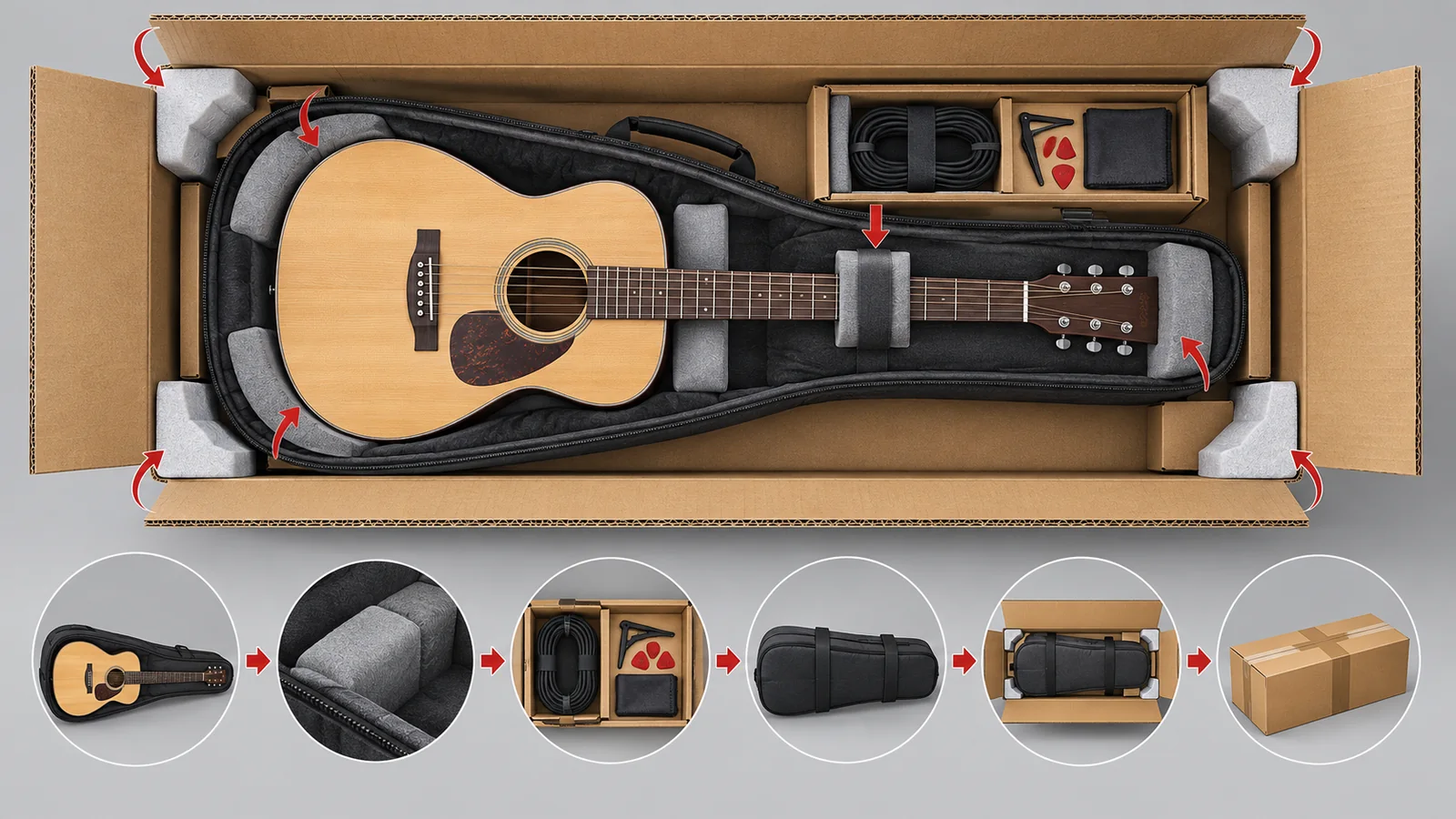
Our guide to guitar packaging for international shipping explains how to connect instrument preparation, restraint, carton design, evidence and receiving instructions.
Reconcile documents before release
The purchase order, commercial invoice and packing list serve different purposes, but their core product information should agree. The U.S. International Trade Administration notes that a commercial invoice supports export and import clearance and that an export packing list normally identifies parties, shipment references, quantities, package types, weights, marks and dimensions. Destination requirements vary, so the importer and freight forwarder should confirm the current documents required for the actual market.
- compare model descriptions and quantities across all files;
- confirm net and gross weights use labelled units;
- check carton counts, carton numbers and shipping marks;
- verify invoice, packing-list and transport references;
- confirm the agreed Incoterms® rule and named place;
- identify any certificate, inspection or origin document requested for the destination;
- keep a final issued set separate from working drafts.
Manage exceptions without losing the baseline
Production and logistics do not always follow the first plan. A component may become unavailable, a finish may need more time, or the buyer may change quantities. Record every exception against the agreed baseline. Include the affected line, proposed response, effect on specification, quantity, price or timing, and whether written approval is required.
Do not let an approved exception silently become the new standard for future orders. At closing, decide whether it was one-time, rejected or incorporated into the next specification revision. This protects repeat-order consistency.
Final guitar order coordination checklist
- One order reference links all commercial, product and logistics files.
- Every line has a model code, revision, finish, quantity and included-item list.
- Units and measurement points are explicit.
- The approved sample is connected to the current specification.
- Changes show old value, new value, effect and approver.
- Product and packaging approval gates have named owners.
- Inspection instructions reference the correct revision.
- Invoice, packing list, carton count, weights and marks reconcile.
- Destination document requirements have been confirmed by the responsible parties.
- Exceptions and final disposition remain traceable for repeat orders.
Frequently asked questions
Is the purchase order enough to control a guitar order?
Usually not by itself. The purchase order should connect to the approved specification, sample record, packaging instructions and any authorized changes. It remains the commercial reference, while the supporting records define the product in enough detail for production and inspection.
Who should approve a product change?
The order should name authorized contacts for commercial and technical decisions. A salesperson or technician may raise a question, but the responsible buyer and supplier representatives should approve changes that affect the agreed order.
Should photographs be part of the order record?
Yes, when they are clearly labelled and connected to a model and revision. Photographs support appearance and visible configuration, but they should not replace written dimensions, materials, electronics or package-content fields.
When should shipping documents be checked?
Review requirements early, then reconcile the final documents against the released quantities and packages before shipment. Waiting until the goods are ready can expose missing market-specific fields or certificates too late.
Conclusion
Reliable order coordination is a controlled sequence of decisions. Establish one order identity, define every line, connect samples and specifications, approve changes, coordinate packaging, reconcile shipment documents and preserve exceptions for the next order. The result is not more paperwork for its own sake. It is a shared record that helps buyers and suppliers act on the same product definition.
Send Your Guitar Order Requirements
Luxars Music works with distributors, music retailers and e-commerce sellers on guitar product and channel requirements. Send your target market, guitar categories, expected quantities and required product-information fields through the inquiry form, WhatsApp +86 13620576554 or sale@luxarsmusic.com. Commercial details are handled privately; this B2B website does not display retail prices.
Sources and further reading
- International Chamber of Commerce, Incoterms® 2020
- U.S. International Trade Administration, Common Export Documents
- U.S. International Trade Administration, Commercial Invoice
- FedEx, How to Ship a Guitar
 English