
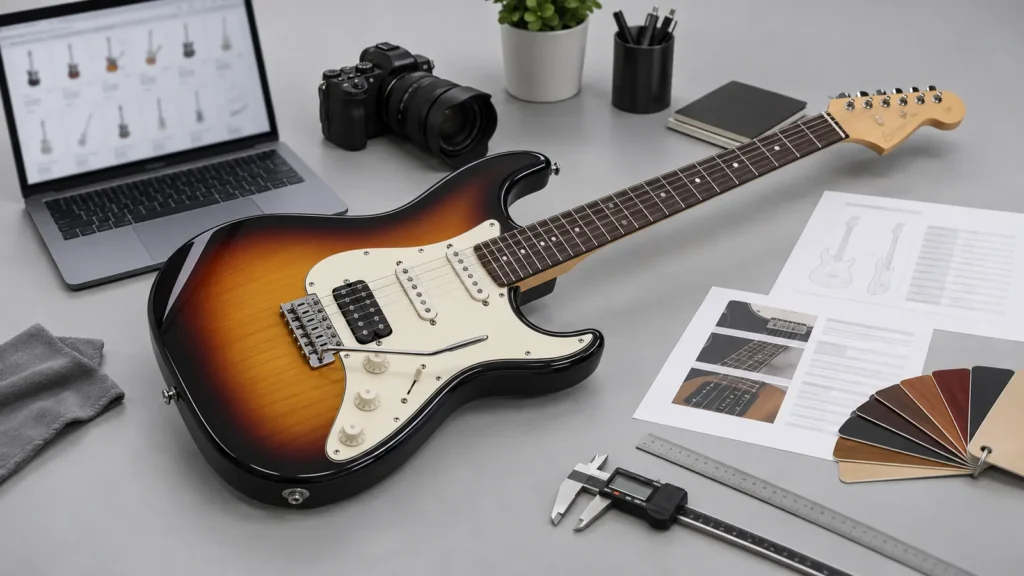
Guitar buyers need more than an attractive photograph and a short material list. A distributor has to compare models, approve a sample, prepare listings, train sales staff, place a repeat order and identify what arrived. Each task depends on product information that is complete, consistent and connected to the correct guitar.
The most useful product record separates identity, measurable specifications, visible configuration, performance-related features, package contents, images, logistics data and revision history. It also distinguishes confirmed facts from optional configurations and marketing language.
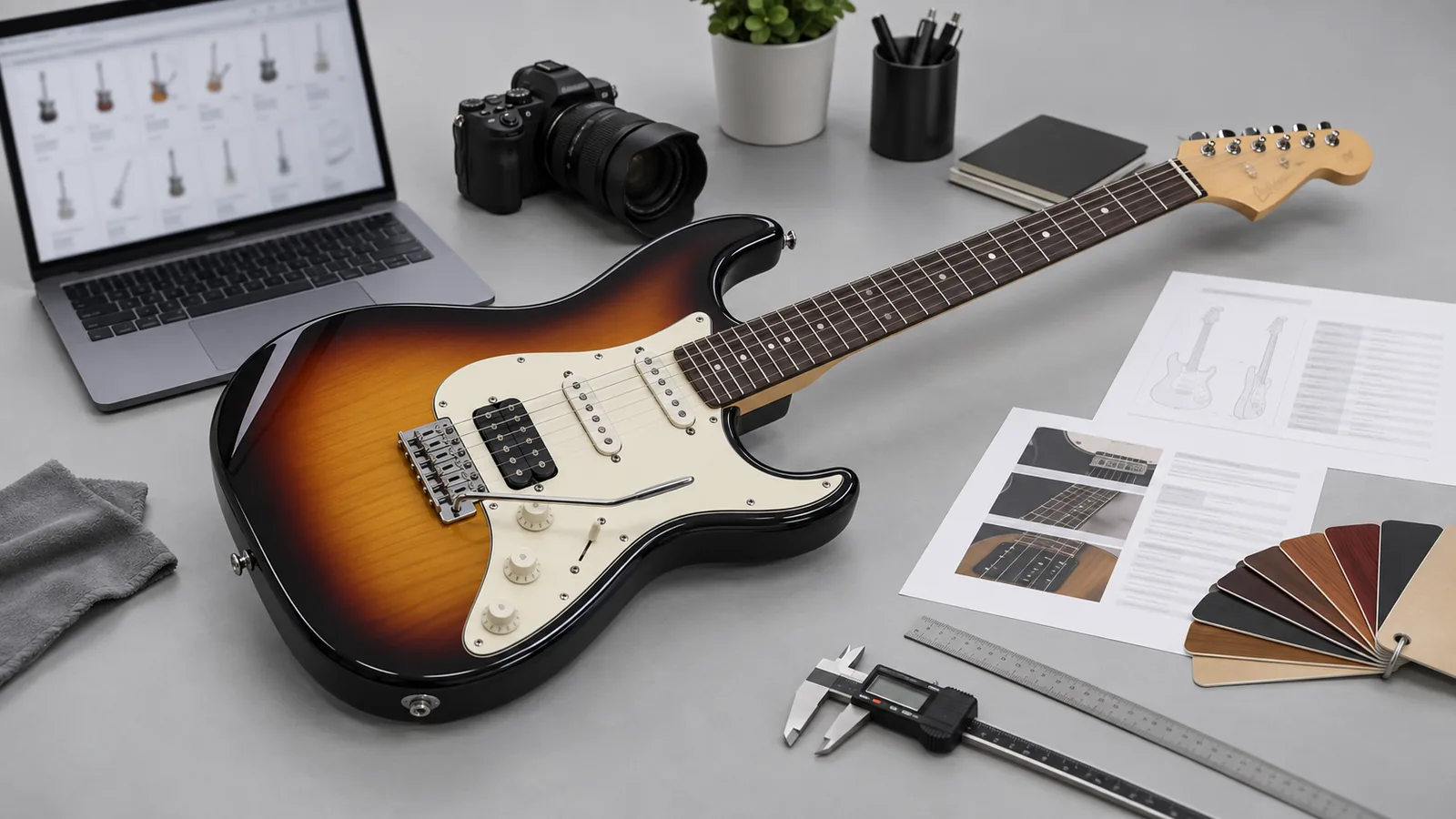
Begin with stable product identity
Every product file should begin with a controlled identity block: brand, model code, product category, version or revision, finish and any market-facing name. The model code should remain consistent across the quotation, specification, sample label, carton, image folder, online listing and repeat order.
A marketing title can be more descriptive than a factory model code, but the relationship must be recorded. If one online channel calls a guitar “Vintage Sunburst Electric Guitar” and another calls it “Beginner HSS Model,” both listings should still map to the same controlled model and configuration.
Separate universal fields from category-specific fields
Some information belongs to every guitar: category, handedness, scale length, nut width, overall dimensions, finish, package contents and shipping measurements. Other fields depend on the category. A useful form should not force classical, steel-string acoustic and electric guitars into one vague template.
| Category | Information buyers should confirm | Common ambiguity |
|---|---|---|
| Steel-string acoustic | Body shape/size, scale, nut width, top/back/side construction, bracing description where approved, bridge, tuners and electronics if fitted | “Solid” used without identifying the part or construction |
| Classical/nylon string | String type, scale, nut width, neck profile, body construction, bridge, tuners and pickup/preamp if fitted | Grouped under “acoustic” without explaining nylon-string geometry |
| Electric guitar | Body/neck/fingerboard specification, scale, fret count, bridge, pickup configuration, selector positions, controls and output | Pickup appearance used instead of a confirmed electronics record |
| Bass | Scale, string count, pickup/control layout, bridge, active/passive system and battery requirement | Control functions missing or copied from a visually similar model |
Measurements should include units and methods. Overall length and carton length are different fields. Body depth can vary depending on where it is measured. Ask for a labelled diagram or a defined measurement point when the number affects fit, display, packaging or customer expectations.
Use precise material and construction language
Material statements are among the easiest fields to copy incorrectly. “Spruce top” does not explain whether the construction is solid or laminated. “Mahogany” may describe a commercial name rather than a precise botanical identification. A photograph cannot confirm hidden layers, species or internal construction.
- identify which part the material describes;
- state solid, laminated or other construction only when confirmed;
- separate visible veneer, core and structural material where relevant;
- use the supplier’s approved terminology consistently;
- confirm any regulated-material or destination documentation with responsible specialists;
- avoid turning an appearance-based assumption into a specification claim.
For a detailed pre-order review, use our guide to evaluating guitar specifications before a wholesale order.

Document hardware and electronics as functions
A hardware list should allow the buyer to identify what is installed and how it operates. For an electric guitar, record bridge type, tuner style, pickup configuration, selector positions, volume and tone controls, output and any active-system power requirement. For an acoustic-electric model, identify the pickup/preamp functions and included battery or accessory policy.
A control layout photograph is useful, but it should be accompanied by a functional description. Two guitars can have visually similar knobs and different wiring. If components may change, define the approval process rather than using “equivalent” without performance, fit and appearance criteria.
Connect finish names to visual references
Colour names are not measurement systems. “Natural,” “vintage sunburst” or “dark red” can cover a wide range. Pair the name with an approved sample, colour reference or dated image set. Note that lighting, white balance, screen settings and natural material variation can affect photographs.
Record gloss, satin or open-pore treatment separately from colour. Identify binding, pickguard, hardware colour and visible appointments if they distinguish one variant from another. When an acceptable range is needed, show representative boundaries rather than one ideal image.
Request Detailed Product Information
Need a clearer product-information structure for your guitar catalog? Send Luxars Music the categories, market and sales channels you are planning. Contact us through the inquiry form, WhatsApp +86 13620576554 or sale@luxarsmusic.com.
Build an image set that answers buyer questions
A complete image set starts with an accurate full-product view and then answers questions about identity, construction, hardware, controls, dimensions, finish, included items and packaging. GS1’s Product Image Specification emphasizes structured views, consistent identification and the relationship between digital assets and product data. A guitar business does not have to copy every GS1 convention to benefit from the principle: images should be consistently named and connected to the correct product record.
- front and back complete-instrument views;
- neck, headstock, fingerboard and fret details;
- bridge, tuners, pickups, controls and output;
- finish and visible material details under neutral light;
- dimension diagram with labelled units;
- included items shown separately from optional accessories;
- packaging and carton identification where receiving teams need it;
- stable filenames linked to model, view and revision.

See our guide to product images and listing data for online guitar sellers for a page-level workflow.
Prepare channel-ready fields without creating contradictions
Retail staff, e-commerce platforms, distributors and marketplaces often request different fields. Keep one approved master record, then map its fields to each channel. Do not maintain unrelated copies that drift over time.
GS1’s Global Data Model describes a layered approach with globally useful core attributes plus category, regional and local attributes. The same logic works for guitar data: keep core identity and measurements stable, add guitar-category fields, then add channel or market requirements.
Google distinguishes between product snippets for pages that provide product information and merchant listings for pages where customers can purchase. Luxars Music is a B2B inquiry site, so pages should present accurate product information and inquiry routes without inserting unsupported retail prices, availability or consumer checkout signals merely to imitate an online shop.
Include packaging and logistics fields
Product information does not end at the guitar. Buyers may need unit weight, packed weight, product dimensions, carton dimensions, units per carton, included protection, barcode or label fields and carton marks. Keep product and packed measurements separate.
Package contents should state what is included with each unit and what is optional. If a bag, cable or tool appears in a photograph but is not standard, label it clearly. This reduces listing errors, receiving discrepancies and after-sales questions.
Control revisions and publication dates
Each product record should show a revision or effective date. When a component, finish, measurement, image or package changes, record what changed and which orders are affected. Replace outdated channel data deliberately rather than simply uploading another file with a similar name.
Maintain a publication checklist: specification approved, images matched, package contents verified, product page updated, downloadable files replaced, structured data reviewed and earlier references archived. The goal is a consistent public record, not an artificial “fresh” date.
Buyer product-information checklist
- Brand, model code, category, revision and finish are stable.
- Measurements include units and defined points.
- Materials identify the part and construction accurately.
- Hardware and electronics describe configuration and function.
- Finish names connect to approved visual references.
- Images cover complete views, details, dimensions and package contents.
- Standard contents are separated from optional accessories.
- Product, carton and shipping measurements are not mixed.
- Channel fields map back to one master product record.
- Changes show revision, effective date and affected orders.
Frequently asked questions
Can buyers confirm guitar materials from photographs?
Photographs can support identity and visible appearance, but they cannot reliably confirm hidden construction, species or material grade. Use the approved written specification for those claims.
How many product images does a guitar listing need?
There is no universal number. The set should answer the buyer’s questions about the complete instrument, back, neck, headstock, hardware, electronics, finish, dimensions and included items without repeating the same angle.
Should every channel use the same product description?
The wording can change for the audience and format, but factual fields must remain consistent. Map channel copy to one approved master record and preserve model identity, dimensions, configuration and package contents.
What should happen when a specification changes?
Record the old and new values, effective date, reason, approver and affected orders. Update related images, channel files and listings, while retaining the earlier revision for traceability.
Conclusion
Confident purchasing depends on a product record that can survive comparison, approval, listing, ordering and receiving. Build stable identity first, add category-specific specifications, connect images and package contents, map fields to each channel and control every revision. Clear data helps a buyer evaluate the product and helps both sides reproduce the agreed configuration later.
Ask for Product Information
Luxars Music supports distributors, music retailers and e-commerce sellers with guitar product and channel information. Tell us which categories, markets and data fields you need through the inquiry form, WhatsApp +86 13620576554 or sale@luxarsmusic.com. Commercial details are handled privately; this B2B website does not display retail prices.
Sources and further reading
- GS1, Global Data Model
- GS1, Product Image Specification Standard
- Google Search Central, Product structured data
- Google Search Central, Share your product data with Google
 English