
Choose six- and seven-string electric guitars by the musical task your customers need to cover, then verify tuning, dimensions and replacement-string requirements for each model. An extra string creates a different comparison; it does not establish a higher product tier. Retailers need a demonstrable reason for each format and enough model-specific information to support it after the sale.
Start with the customer’s intended use
A customer moving from an existing six-string guitar may want familiar chord shapes, a different tuning, additional lower notes or a new playing layout. Ask which of those needs matters. A description such as “for heavier music” leaves the retailer without a useful test: it says nothing about the tuning, string set or passages the customer expects to play.
Give each candidate a clear role in your range. A six-string model might meet the same customer’s needs with fewer changes to their current routine. A seven-string model may provide an additional part that the six-string shortlist does not cover. These are choices to test with the customer, rather than a required progression from beginner to advanced.
Record string count and tuning separately
String count alone does not specify the intended tuning. For a concrete manufacturer example, Ibanez lists tuning and scale separately for its RGMS7. That record describes that Ibanez model; it does not establish the setup of a LUXARS guitar.
Before comparing samples, write down the actual tuning and every gauge in the fitted string set, in order and with units. Confirm the intended setup with the model’s current specification or supplier. Keep the customer’s proposed tuning in a separate field if it differs. This makes the change visible before anyone promises that a particular replacement set or setup will work.
| Decision | Six-string shortlist | Seven-string shortlist |
|---|---|---|
| Musical role | Identify the part and tuning the customer needs. | Explain what the additional string contributes to that part. |
| Physical comparison | Record the exact model’s dimensions and spacing. | Check the actual sample; do not infer dimensions from string count. |
| Replacement information | Confirm the full set, string ends and fitting requirements. | Confirm all seven strings and the model’s fitting requirements. |
| Catalogue role | Keep a distinct reason to stock the model. | Check that the new format addresses a real gap. |
Compare the actual neck and bridge
Ask for scale length, nut width and defined string-spacing measurements where they affect the buying decision. Those fields describe different things. A width measured across the outside of the nut is not the distance between string centres. A guitar described only as “seven-string” still needs its own dimensional record.
During a demonstration, let the player try familiar passages, chord changes and muting in the intended tuning. Record their observations with the model and sample identity. If a dimension is missing, request it or measure the identified sample with a stated method. Do not reuse measurements from a visually similar instrument.
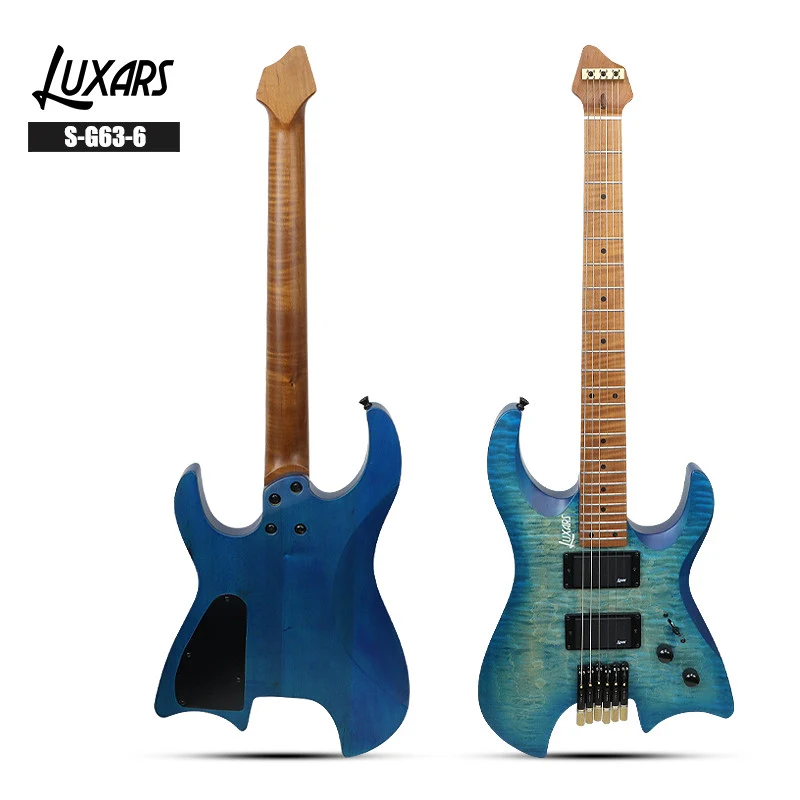
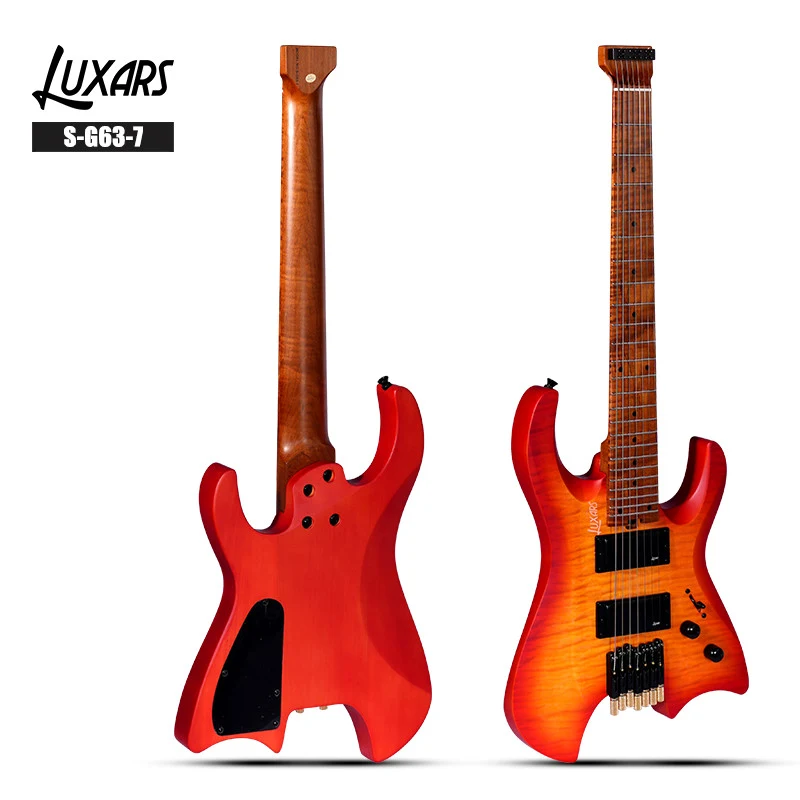
The LUXARS S-G63-6 and S-G63-7 provide a useful documented pair: six- and seven-string headless formats, each with an HH pickup layout and bridge-based tuning. The approved records identify a linden body with flamed maple veneer and a roasted-maple neck and fingerboard. These shared specifications make the string-format comparison relevant; they do not supply missing scale or spacing measurements.
Resolve replacement strings before adding the SKU
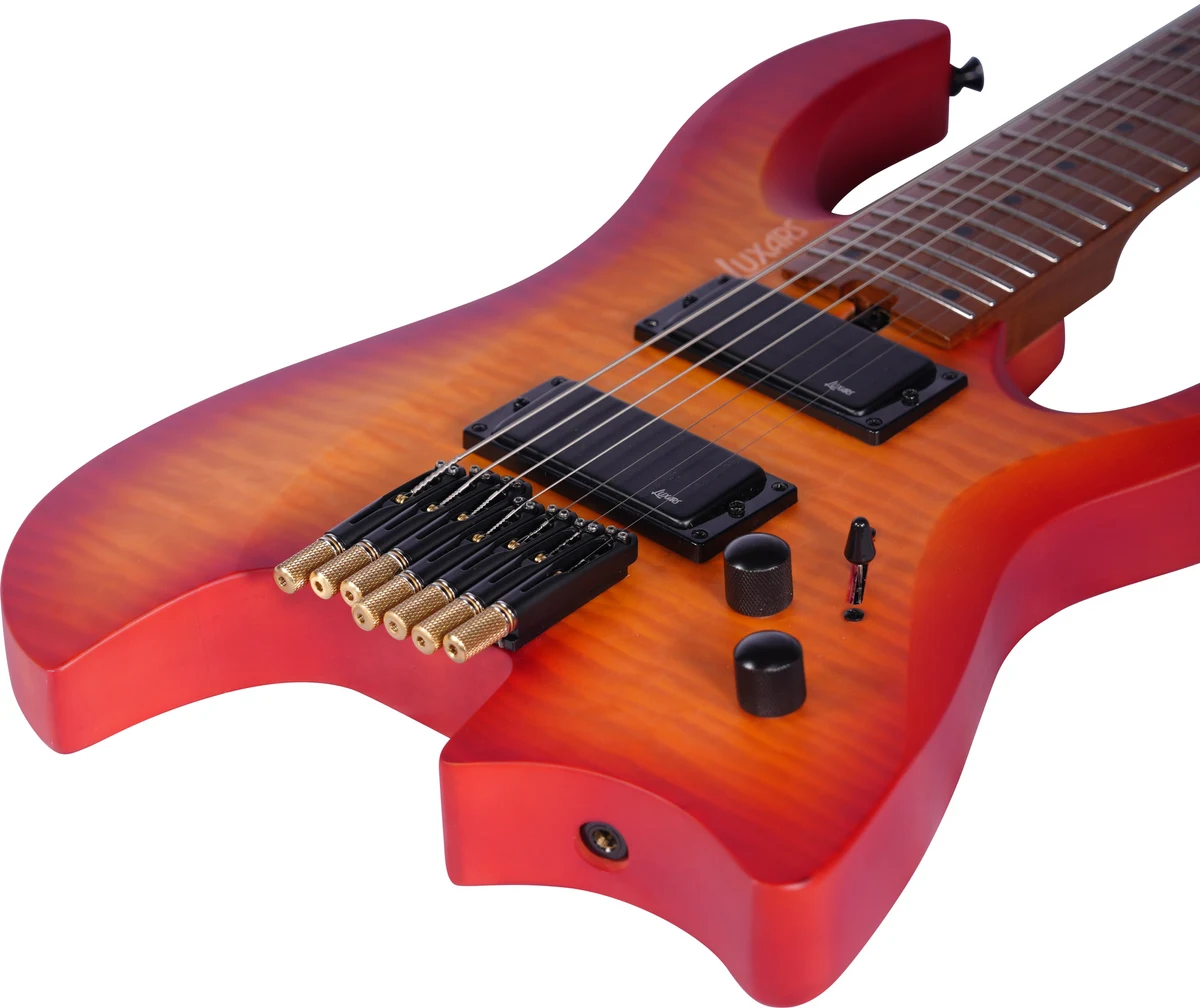
Keep the full ordered gauges, string-end requirements and fitting instructions with the model record. Confirm whether a proposed set suits the particular bridge and string-retaining hardware. A headless outline or the number of bridge tuners cannot settle every replacement-string requirement.
A retailer should be able to identify the set used on the demonstration sample and explain what information is needed for a replacement. If a customer requests another tuning or gauge, route that request through an appropriate setup assessment. The headless compatibility guide and string-gauge change guide cover those separate checks.
Prepare one comparison card for staff and listings
Use the same fields on the shop card, online listing and internal sample sheet: exact model, string count, current tuning, complete fitted set, confirmed dimensions, bridge type, control description and the source revision. Link the approved photographs to the correct variant. A photograph of one format should not silently become the listing image for the other.
Keep the sales decision separate from any service work. A staff member can document the customer’s intended use and explain the published format. A technician can assess a requested setup change using the actual instrument and suitable instructions. Record unresolved requirements before confirming the customer’s final choice.
Two questions during selection
Is a seven-string automatically a longer-scale guitar?
No. Obtain the scale measurement for the exact model. The seventh string and the scale length are separate specification fields.
Can a six-string and a seven-string share the same listing?
They can be connected as related options, but each needs an unambiguous variant identity, correct photographs, string count and its own applicable specifications. Keep those differences visible before the buyer selects an option.
Build a shortlist your team can support
Compare the current electric guitar records, then send your intended tuning, customer use and shortlisted models to sale@luxarsmusic.com. Ask for the missing model information before discussing quantities or setup changes.
 English