

A change of guitar string gauge should start with the exact model, the complete replacement set and the intended tuning. Gauge, tuning and string construction affect tension, and a gauge change may require setup work. Check the instrument’s attachment requirements, then assess it after fitting and tuning. Confirm compatibility and any required adjustments before describing the replacement as ready to use.
Jump to a section
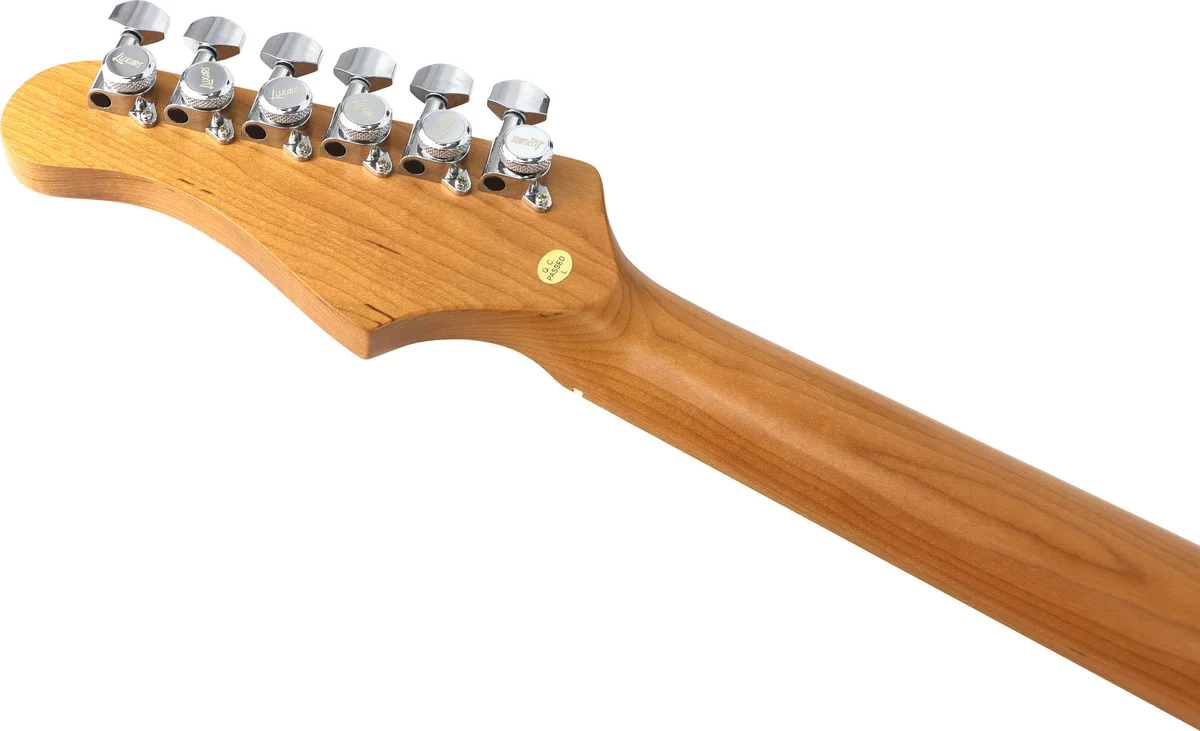
Actual S-G25 instrument and bridge photographs. The images show the model and hardware, without establishing a string gauge or tension.
Read the complete string set
Gauge describes string diameter, but a shop’s shorthand may name only one part of a set. A customer asking for “10s” has not supplied every string’s diameter, construction or end type. Ask which product is being replaced and whether the customer wants the same set or a different feel or tuning.
D’Addario’s electric gauge guide illustrates why the full designation matters: it lists both 10-46 and 10-52 combinations. They share a first-string gauge while differing at the bass end. These are examples from that manufacturer’s range, not LUXARS factory string specifications.
Record the manufacturer’s set identifier and full gauge sequence when available. Add material, wound-string construction and end type where they affect selection. If the old packaging has been lost, treat the identification as a question to resolve; the appearance of strings in a product photograph cannot establish their diameters.
Keep gauge, tuning and scale length together
D’Addario’s String Tension Pro explanation identifies gauge, scale length, tuning and string construction as factors in string tension. Comparing gauge labels alone leaves out part of the setup. A tension calculation also needs the correct string information, not an assumed material or construction.
The LUXARS S-G25 lists a scale length of 648 mm / 25.5 inches, a two-point tremolo and locking tuners. Keep those published fields in the model record. They do not establish a factory gauge or an approved range of replacement gauges, so request the string and setup information relevant to the actual model.
For a customer’s instrument, note the intended tuning before selecting strings. If the customer changes the set and tuning at the same time, record both changes. Sales staff can then explain what was requested, and the technician can assess the resulting instrument rather than working from a vague instruction to fit heavier strings.

| Information to confirm | Example of a useful record | What it cannot establish alone |
|---|---|---|
| Instrument | Exact model and relevant version | Compatibility from a similar body shape |
| Replacement set | Manufacturer, identifier and complete gauges | The full set from the word “10s” |
| Tuning | Intended pitch of each string | Suitability from gauge alone |
| Scale length | Published model value | A string-tension result without string construction |
| Attachment | End type and the instrument’s fitting instructions | Fit from a photograph of the bridge |
| Setup assessment | Observations after tuning and any work completed | That every gauge change needs the same adjustment |
Request the string information your team needs
Share the model, proposed set and intended tuning. Ask LUXARS about string compatibility and setup information before adding an unverified gauge recommendation to a product listing.
Check the instrument category and attachment
Select strings intended for the instrument’s construction. Nylon-string guitars and steel-string instruments have different requirements. Córdoba’s FAQ explicitly warns against putting steel strings on nylon-string guitars because of the risk of damage.
End fittings also matter. Identify the bridge and tuner system and use the model’s instructions. A headless guitar needs its own compatibility information; the presence of a clamp in a photograph is not confirmation that every string end or gauge can be used. The headless guitar guide covers those model-information questions in more detail.
For the R2-K and R2-M acoustic models, the confirmed fitted-string description is LUXARS strings. That brand field is not a complete gauge sequence. Ask for the current set details instead of deriving a recommendation from another model or from a similar-looking packet.
Model details for this comparison
Open the model specification and request the measurements needed for your comparison.
LX-E09
Published model fields
- Number of strings
- 6
- Gauges, string 1 onwards (inches)
- 0.009 / 0.011 / 0.016 / 0.024 / 0.032 / 0.042 in
Confirm end fittings, usable string length and compatibility with the intended instrument and tuning before fitting this set.
Ask about LX-E09LX-E10
Published model fields
- Number of strings
- 6
- Gauges, string 1 onwards (inches)
- 0.010 / 0.013 / 0.017 / 0.026 / 0.036 / 0.046 in
Confirm end fittings, usable string length and compatibility with the intended instrument and tuning before fitting this set.
Ask about LX-E10LX9-E09-7
Published model fields
- Number of strings
- 7
- Gauges, string 1 onwards (inches)
- 0.009 / 0.011 / 0.016 / 0.024 / 0.032 / 0.042 / 0.058 in
Confirm end fittings, usable string length and compatibility with the intended instrument and tuning before fitting this set.
Ask about LX9-E09-7Assess the setup after the strings are fitted
Fender’s Stratocaster setup guidance states that changing gauge may require adjustments. It also explains the balance between strings and springs on a floating tremolo. This supports the need to assess the instrument; Fender’s numerical settings are not LUXARS settings.
For a retail service, agree on the work being requested and who will perform adjustments. After installing the compatible set according to the model’s instructions, tune the instrument and assess playing behavior. Record any buzzing, binding, pitch issue or change in bridge position that needs attention. Have an appropriate technician examine the relevant setup fields rather than applying one automatic correction to every guitar.
A fixed bridge removes the floating bridge’s spring-balance task, but it does not remove every setup question. Neck relief, string height, nut fit and intonation may still need assessment. Use approved model procedures for any work. Do not enlarge nut slots, turn adjustment screws or prescribe torque from a general buying guide.
Make the handover useful for the next string change
Give the customer the replacement set’s product details and the tuning used for the assessment. Record any completed setup work and the observations it addressed. Distinguish a customer’s preference for feel from a fault that still needs service. This information helps a later technician understand the current instrument without assuming it remains in its original configuration.
For stock guitars, keep the string-change record with the exact unit or demonstration instrument. If a display guitar has been restrung, sales staff should not describe the fitted strings as its factory set. An e-commerce listing for the model should use confirmed supplied configuration, while a particular instrument’s changed configuration needs its own accurate description.
Questions before fitting a new set
Are all sets called “10s” the same?
The shorthand usually identifies the first string. Check the full gauge sequence and product details. D’Addario’s 10-46 and 10-52 examples show why the bass strings also matter.
Does the same scale length guarantee the same tension?
Tension also depends on tuning and string construction, along with gauge. Use the relevant string manufacturer’s data for a calculation and keep its assumptions visible.
Does every gauge change require a truss-rod adjustment?
Assess the actual instrument. A different gauge may require setup work, but that does not establish one necessary adjustment for every guitar. Use model instructions and an appropriate technician.
Can a string-brand field be used as a gauge recommendation?
It identifies the brand. Obtain the set identifier, gauges and compatibility information separately before making a model-specific recommendation.
Plan a clear accessories and service conversation
Read the fixed bridge and tremolo guide for bridge selection, and compare the LUXARS accessories range with the verified needs of the guitars you carry.
Send LUXARS your company, market, model and string-information questions. Request product and compatibility information, email sale@luxarsmusic.com, or use WhatsApp +86 13620576554.
 English