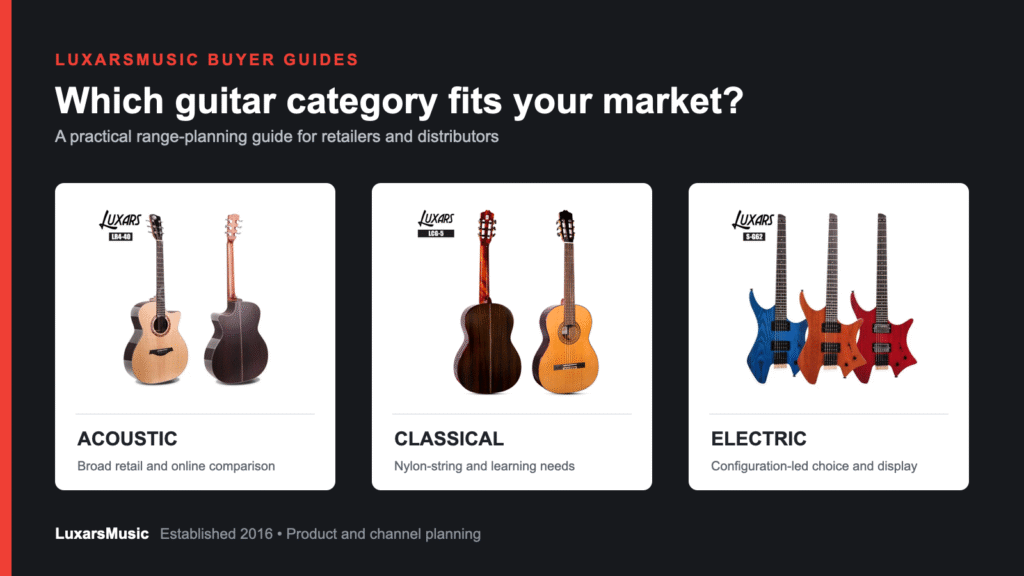
The right guitar category depends on the job it must do in your market. Acoustic guitars often provide broad entry and singer-songwriter appeal; classical guitars answer nylon-string, learning and specialist needs; electric guitars create more configuration-led choices. A useful range starts with customers and channels, then gives each category a clear role instead of stocking all three by habit.
Key takeaways
- Choose categories from customer use cases and sales channels, not from catalog size.
- Acoustic, classical and electric guitars require different product information, staff knowledge and comparison logic.
- A small, well-defined mixed range can be easier to sell than a large assortment with overlapping models.
- Use sales questions, search behavior and inquiry records to decide which category should lead and which should support.
Begin with the market job, not the instrument label
“Which category sells best?” is usually the wrong first question. A distributor serving independent music stores has a different task from an online seller building comparison pages or a supplier working with music schools. The category decision should begin with three practical points: who the buyer is, where the product will be explained and what problem the range must solve.
For example, a store may need an acoustic model that a new customer can understand quickly, a nylon-string option for a teacher-led purchase and an electric range with visible configuration differences. An e-commerce seller may want the same categories but require more structured images and specification fields. A regional distributor may begin with fewer models because every extra SKU affects product records, translation, inventory planning and dealer training.
The useful question is therefore: What should this category contribute that the other categories do not? If the answer is unclear, adding products will not make the range clearer.
| Category | Common market role | Information buyers need | Planning risk |
|---|---|---|---|
| Acoustic | Broad first-instrument, songwriting, casual playing and unplugged use | Body format, size, string type, main materials, cutaway and electronics where applicable | Too many similar body, finish or specification combinations |
| Classical | Nylon-string learning, teacher-led demand and specialist playing needs | String type, size, scale length, nut width, body format and electronics where applicable | Treating it as a softer version of a steel-string acoustic guitar |
| Electric | Style-led selection, amplified playing and clear step-up configurations | Body construction, scale length, pickup layout, controls, bridge, hardware and finish | Adding cosmetic SKUs without meaningful configuration roles |
When acoustic guitars should lead the range
Acoustic guitars are often the easiest category to explain across several channels. Customers can see the overall body format, compare compact and full-size options and understand whether electronics or a cutaway are relevant to their use. That does not mean one acoustic model fits every market. A range still needs distinct roles.
A practical acoustic assortment might separate a straightforward core model, a compact alternative and a step-up option with visible construction or feature differences. Those roles should remain clear in the quotation, product page and staff notes. If two models use nearly identical descriptions, images and customer explanations, they may be competing for the same position.

Acoustic can be the lead category when your audience includes general music retailers, first-time buyers, singer-songwriters or customers who want an instrument that does not depend on additional amplification. It can also support online selling well, provided the page publishes accurate size, body, string and material information rather than relying on a front image and a model name.
When classical guitars deserve a separate role
Classical guitars should not be grouped with steel-string acoustics simply because both can have a full hollow body. The nylon-string format, neck dimensions and playing context change what a buyer needs to know. Teachers, students and players looking for a particular feel may ask different questions from a customer comparing acoustic body shapes.
This category can lead where music education, teacher recommendations or established nylon-string demand are important. In a general retail range, it may work better as a focused supporting category: fewer models, clearer size or specification roles and enough information for staff to explain the difference without vague claims about one category being “easier” for everyone.
Product records should state nylon-string construction clearly and include the measurements relevant to comparison. Avoid turning general assumptions into promises about comfort or tone. A player’s technique, size preference and learning plan matter, so the page should give usable facts and let the buyer decide with a teacher or retailer when appropriate.
When electric guitars create the strongest category story
Electric guitars give retailers more visible ways to separate product roles, but they also demand more disciplined information. Pickup configuration, switching, controls, bridge design, body style, hardware and finish can all affect how a model is positioned. A customer cannot judge those differences from color alone.
Electric can lead in stores and online channels where customers already compare configurations, follow style-specific products or expect a clear path from a first instrument to a more specialized model. It can also create strong display impact. The risk is assortment inflation: several finishes or small specification changes may look like range depth while creating duplicated records and slow-moving SKUs.

Before expanding electric selections, define which difference a salesperson or listing page will communicate. If the explanation is only “another color,” decide whether the expected demand justifies another SKU. If the pickup layout, controls, format or intended user changes, make that difference visible in both images and specification fields.
Match the lead category to the sales channel
| Sales channel | Useful lead-category question | Evidence to review |
|---|---|---|
| Independent music store | Which category can staff demonstrate and explain consistently? | Customer questions, staff knowledge, display space and local lesson demand |
| E-commerce seller | Which category has enough accurate images and structured data for comparison? | Search terms, page engagement, returns questions and listing completeness |
| Music school supplier | Which instruments match the teaching program and teacher recommendations? | Required sizes, string type, course level and replacement needs |
| Regional distributor | Which category gives dealers a clear core range without excessive overlap? | Dealer inquiries, current gaps, catalog roles and product-document workload |
Which category should lead in your market?
Share your country, sales channel, current assortment and the customer groups you want to serve. LuxarsMusic can begin with the category roles and product information your team needs to review.
Build a mixed range without losing clarity
Many retailers need more than one category. The goal is not to force the market into a single choice; it is to decide which category is core, which fills a specific gap and how customers move between them. A mixed range becomes confusing when every model is treated as equally important.
- Write a one-sentence market brief. Name the country or region, channel, main buyer groups and the gap you want to fill.
- Give each category a job. Label it as lead, supporting or specialist rather than assigning equal space automatically.
- Give every model a reason to exist. Use size, string type, body format, configuration, feature group or intended user—not a minor naming change.
- Check the information workload. Confirm that images, specification fields, translations and staff explanations can stay accurate for every SKU.
- Review real questions after launch. Search queries, sales conversations and inquiry forms can show which category needs clearer content or a different product role.

A seven-question category review
- Who is the main buyer for this category in our market?
- Where will the product be explained: store, marketplace, school or dealer catalog?
- Which specifications does that buyer compare first?
- What makes each model different enough to justify its SKU?
- Do the available images show those differences accurately?
- Can staff and product pages explain the category without unsupported claims?
- Which inquiry, search or sales signal will tell us whether to expand or simplify?
Frequently asked questions
Should a new music retailer begin with all three guitar categories?
Not necessarily. Begin with the category you can explain, document and support most clearly, then add a second category when it fills a defined customer need. A smaller range with distinct roles is easier to evaluate than three shallow categories added only for completeness.
Is acoustic guitar always the safest first category?
Acoustic guitars can serve broad use cases, but “safest” depends on local demand and channel capability. A school-led market may have stronger nylon-string needs, while a specialist store may be better prepared to sell electric configurations. Use customer evidence rather than a universal rule.
How many models should each category contain?
There is no fixed number. Start with the minimum set that covers meaningful user or specification roles. Add a model when it answers a repeated need that the current range cannot serve; remove or combine SKUs when staff and buyers cannot explain the difference.
What information matters most for comparing categories online?
Publish the string type, body or construction format, key dimensions, main materials, electronics where applicable, finish, included items and clear images. Electric listings also need accurate pickup, control, bridge and hardware information. Keep names and values consistent across images, specifications and quotations.
When should a distributor change the category mix?
Review the mix when repeated dealer inquiries reveal a gap, when several SKUs compete for the same role, when product information cannot be maintained accurately or when a channel changes. Use several signals over time rather than reacting to one isolated request.
Plan the category roles before choosing more models
LuxarsMusic has worked with guitar product and channel requirements since 2016. If you are reviewing acoustic, classical or electric categories, tell us how your market sells, teaches or distributes guitars. The first useful step is to define the buyer, category role and information requirements before extending the model list.
Continue with our guides to choosing acoustic guitars for a catalog, comparing classical and acoustic guitars, and planning an electric guitar assortment. You can also browse LuxarsMusic products, contact us on WhatsApp +86 13620576554, or email info@luxarsmusic.com.
 English