

A headless electric guitar needs a different product demonstration from a guitar with tuning machines on its headstock. Before adding one to a retail range, establish how its strings attach, where tuning happens, which replacement strings fit and how the instrument sits on a stand. These answers help a shop explain the actual model and prepare the accessories and service information a customer will need.
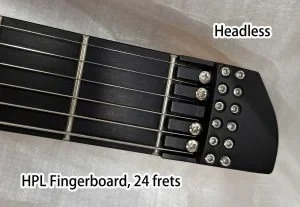
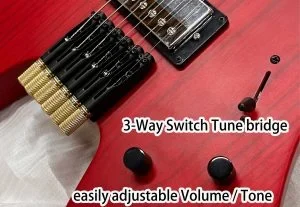
S-G62 product photographs. The photographed finishes identify model options; they do not specify replacement-string compatibility.
Start with the string system
Headless describes the absence of a conventional headstock. It does not identify one universal bridge, string attachment or replacement-string specification. A buyer should be able to follow the string from the neck end to the body end and identify the parts used for attachment and tuning. Use the model’s own instructions when preparing a demonstration.
Two manufacturers’ documents show why the distinction matters. Steinberger’s Synapse instructions describe both double-ball strings and the instrument’s procedure for single-ball strings. Strandberg’s EGS Rev 7 string-change guide discusses string locks and fitting constraints associated with that hardware. These are examples of different systems, not fitting instructions for a LUXARS guitar.
For the model you intend to stock, request the accepted string-end format, fitted gauges, intended tuning and usable string length. Where a clamp or tuner imposes a fitting limit, ask for that limit and the relevant part reference. A packet labeled for electric guitar does not establish that its strings will fit a particular headless instrument. The winding near the ball end and the length available for attachment can matter as well as the nominal gauge.
Read the S-G62 as a model, not a category promise
The current LUXARS S-G62 page identifies a headless electric guitar with Alnico V HH pickups, an HPL fingerboard with 24 frets, a maple neck, and volume, tone and three-way switching. Those fields help establish the model’s identity and electrical layout. They do not provide a complete replacement-string or service-parts specification.
Treat the photographed finishes as identifiable options and keep the chosen version attached to the enquiry. Ask LUXARS to confirm the string attachment, replacement-string requirements, fitted gauges, tuning and hardware instructions for the version being discussed. A photograph of the clamp is useful for recognizing the part; it does not establish a tightening torque or approved gauge range.
| Buyer question | Evidence to request | What the shop can explain |
|---|---|---|
| How are the strings secured? | Model instructions and labeled hardware photographs | Where attachment and tuning take place |
| Which replacement strings fit? | End format, gauges, tuning and fitting limits | Which confirmed string sets to keep available |
| Which tools are needed? | Tool sizes and included-items list | What is supplied and what service staff must obtain |
| How does the guitar fit a stand or bag? | Instrument dimensions and an actual fit check | Which accessories have been checked with that model |
| Which parts can be identified for service? | Hardware references and support procedure | What information to include in a parts enquiry |
Demonstrate tuning before discussing convenience
A useful demonstration starts with the actual tuning controls. Let the player locate them, understand which string each control affects and see whether the controls remain accessible in their normal playing position. Compare this experience with a familiar guitar. The aim is to establish whether the mechanism and position suit the customer, rather than assuming that an unfamiliar design will be easier for everyone.
If a customer asks about changing strings, explain the documented process and the replacement requirements. Staff should practice only with the correct model instructions and tools. Avoid treating a manufacturer’s procedure for another bridge as a shortcut. Keep adjustment work separate from the sales demonstration when it needs a technician or a supplier response.
Record any unusual resistance, slipping or uncertain part identification precisely. A note such as “the third-string tuner does not turn freely during the documented adjustment” gives a technician more to investigate than “the tuning is bad.” Include the model, string set, tuning and a clear photograph. Do not try to solve an unidentified problem by increasing clamp force.
Check support in the positions customers use
Body shape, strap position and the location of the controls all contribute to how an individual guitar feels. Examine the sample seated and standing when those positions matter to the intended buyer. Note how the body rests, where the picking hand sits and whether the player can reach the controls. A headless outline alone does not establish the instrument’s weight or balance.
Test the actual stand or wall-support arrangement intended for the shop. A support that normally holds a guitar at its headstock may need a different approach for a headless instrument. Follow the support manufacturer’s instructions and check the instrument’s stability. Do the same for the bag or case: verify the interior fit, protection of the tuning hardware and useful clearance around the controls.
For an online listing, include a full instrument view, a close-up of the neck-end attachment and a view of the bridge and tuning controls. These images answer different questions. Keep photographs tied to the model and finish, and put confirmed dimensions in text. A compact-looking photograph is not a measurement or a transport-compatibility claim.
Prepare a headless model enquiry
Send LUXARS the model reference, market, intended tuning and the replacement-string information your shop needs. Include the stand or case you plan to evaluate. Request the model’s compatibility and service information before listing a string set or accessory as a confirmed match.
Stock accessories around verified requirements
Build the accessory discussion from the instrument’s requirements. Start with a confirmed replacement string set, the specified tools, a suitable support and a checked bag or case. Establish whether each item is included with the guitar or supplied separately. The accessory list should describe an actual proposed package, not an assumption carried over from another instrument.
The same discipline helps a distributor preparing several sales channels. A shop may need demonstration instructions and spare strings; an online seller may need labeled photographs and fitting details. Give each channel the information it will use, while keeping the underlying model record consistent. Do not promise service parts, local availability or delivery times until those arrangements are confirmed.
Use one record for the demonstration and the listing
Keep the model, finish, string set, tuning, attachment instructions and accessory checks together. Add the date and version of the supplier information. If a string set or hardware version changes, review the affected listing and demonstration notes before continuing to recommend the old combination.
The record can also explain why a model has a place in the range. Describe the features a customer can inspect and the support the shop can provide. Avoid general claims that headless guitars always tune better, weigh less or fit every travel bag. Those statements need evidence about the particular instrument and the proposed comparison.
Frequently asked questions
Do all headless guitars use double-ball strings?
No. String systems differ. Steinberger’s Synapse instructions and Strandberg’s EGS documentation illustrate distinct attachment and fitting procedures. Confirm the accepted string format for the particular guitar before recommending replacements.
Does HH identify an active pickup system?
HH describes two humbuckers. It does not, by itself, establish whether pickups or other electronics are active or whether a battery is required. Ask for the model’s electrical specification when those details affect the demonstration.
Does a headless guitar automatically weigh less?
The outline is not a weight specification. Request the actual model’s weight information and assess its handling in the positions the customer uses. Keep any sample measurement identified as a measurement of that sample.
Can a conventional guitar stand hold a headless guitar?
That depends on the support design and the instrument. Check the support manufacturer’s instructions and the actual fit. A system intended to suspend an instrument by its headstock cannot be assumed to support a headless guitar in the same way.
What should a retailer request about S-G62 string changes?
Request the version-specific attachment instructions, accepted string format, fitted gauges, tuning, fitting limits and required tools. The published HH and 24-fret fields do not answer those compatibility questions.
Sources and related guides
- LUXARS S-G62 product information.
- Steinberger Synapse tuning and string instructions and Strandberg EGS Rev 7 string-change guide, as system-specific examples.
- Continue with the fingerboard-radius comparison guide or the fixed-bridge and tremolo guide.
Discuss the model your shop will support
Tell LUXARS your company, market, sales channel and the headless models you are considering. Include the string, hardware and accessory questions your team needs answered. Request product information, email sale@luxarsmusic.com, or contact WhatsApp +86 13620576554.
 English